What an Oahu household can do before June 1, and in the hours after a storm appears in the forecast: your coverage, the house, a two-week kit and a record of everything you own.
This guide is in order of time. Most of it belongs to the calm months before the season, when there is time to make phone calls, buy supplies and fix things properly. A shorter part covers the day or two after a storm shows up in the forecast. Once a storm is here, the people to listen to are emergency officials, and a separate guide of ours covers what comes after.
The short answer: three things to do before June
Hawaii’s hurricane season runs from June 1 through November 30. The Hawaii Emergency Management Agency notes that August and September have historically been the peak months. A hurricane is a storm with sustained winds of 74 mph or more, but a weaker tropical storm can still bring days of heavy rain to Oahu.
If you only get to three things this year, make them these:
- Confirm your coverage. In Hawaii, hurricane insurance and flood insurance are usually separate from a standard homeowners policy, and flood coverage cannot be bought at the last minute.
- Build a 14-day kit. Two weeks of water and food for everyone in the house, pets included.
- Record your home on video. Every room, every closet, stored somewhere other than your phone.
The sections below take each one in turn, then cover the house itself and what to do when a storm is actually on its way.
Before the season: check your coverage while you still can
Pull out your policy and find the declarations page, the summary at the front. You are looking for three answers.
Do you have hurricane coverage? According to the Hawaii Insurance Division, most standard homeowners and renters policies do not cover hurricane damage, and hurricane insurance has to be bought as its own policy or added to your existing policy as an endorsement. If you have a mortgage, your lender will require it. If you own your home outright, it is your choice, and the Division’s hurricane insurance FAQ encourages owners to consider it before a storm, not during one.
What is your hurricane deductible? Some policies carry a separate deductible for wind and hurricane losses, and it can be a percentage of the amount your home is insured for rather than a flat dollar figure. Because a percentage is worked out on the insured value, even 2 percent can be a large sum. Knowing that number now tells you how much to keep in savings.
Do you carry flood insurance? The Insurance Division is clear that flood damage is not covered by hurricane insurance. The difference comes down to how the water gets in, and it is the reason to check both policies before the season rather than after:
- If the wind tears off part of your roof or breaks a window and rain pours in through the opening, that is the kind of loss hurricane coverage is written for.
- If water rises into the house from an overflowing stream, runoff from the slope above you or storm surge, hurricane insurance does not pay for it. That takes a flood policy.
Most flood insurance in the U.S. is written through the National Flood Insurance Program. Timing matters here: FloodSmart says new coverage goes into effect 30 days after the date of purchase, with a few exceptions such as buying it while you take out or refinance a mortgage. By the time a storm appears in the forecast, a new policy will not start in time to cover it.
Our guide to insurance coverage for damage restoration in Hawaii explains how these policies work together. This is general information, not insurance advice, so confirm the details of your own policy with your agent or carrier.
Before the season: protect the house
Most of this work takes days or weeks to arrange, so it belongs before June, not the afternoon a storm is forecast. The Hawaii Emergency Management Agency’s hurricane page lists the main steps.
Roof-to-wall connections. Hurricane clips or straps are metal connectors that tie the roof to the walls, so wind is less likely to lift it off. A contractor can tell you what your roof has and what retrofitting would involve. The Insurance Division notes that some insurers give premium credits or discounts for retrofits like these, so ask yours before you start.
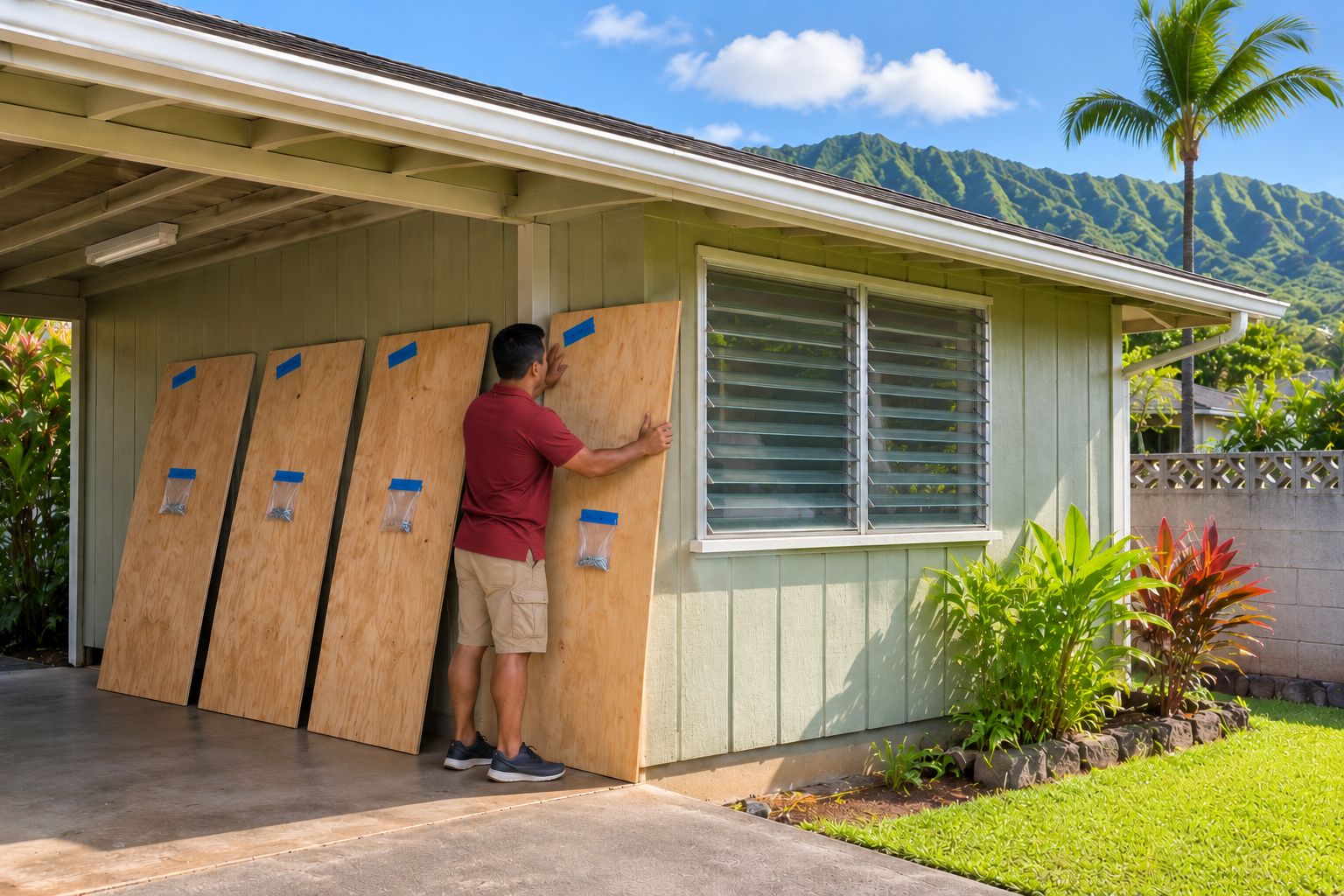
Window protection. Permanent hurricane shutters, such as accordion or roll-down shutters, are the simplest to use when the time comes. The lower-cost alternative is plywood panels cut to fit each window and glass door ahead of time. Label each panel with the opening it fits, drill the holes, and store the panels with the hardware so you are not cutting wood in a hurry.
Garage door. Garage doors tend to buckle under hurricane winds. Bracing products can make a door stronger and more wind resistant, so check whether yours can take one.
Jalousie windows and lanai sliders. Louvers that no longer close tight let wind-driven rain straight through. Replace cracked or missing glass slats and adjust the operators so the louvers seal, or plan to cover those windows with panels. For sliders, clear the drain holes in the track and check the weatherstripping, so water that collects at the threshold can drain out instead of running inward. If you want to know what water damage at these spots looks like after a storm, our checklist of signs of water damage in your home goes room by room.
Trees. Have dead or weak branches over the roof, the lanai and power lines trimmed before the season, while tree crews have time. Trimmings go in your green cart, which the City collects every other week.
Gutters and drains. Clean them out before the season and again if a storm is forecast, so heavy rain runs off and away from the house instead of over the edge and down the walls.
Before the season: build the kit and record your home
The kit. The Hawaii Emergency Management Agency recommends two weeks of emergency supplies, with one gallon of water per person per day for drinking, cooking and hygiene. For a household of three, that is 42 gallons. Along with water and food that keeps, plan for:
- Prescription medicines, refilled ahead of time, and a first aid kit
- A battery-powered or hand-crank radio, with spare batteries
- Flashlights and phone power banks
- Copies of your insurance policies and identification in a waterproof container, or saved electronically
- Some cash, since card readers do not work without power
- Two weeks of food and water for your pets
The record. Before the season, walk through your home and film each room slowly, wall by wall. Open closets, cabinets and drawers and film what is inside. Say what the larger items are as you go: roughly when you bought them, what condition they are in, and what you paid if you remember. The Insurance Division suggests this kind of video inventory as an easier alternative to writing everything down.
Then store the video somewhere other than your phone, such as a cloud account, and keep your insurer’s name, your policy number and the claims phone number with it. If you ever have to file a claim, a dated record of what each room looked like before the storm is far easier to work from than trying to remember afterward.
When a storm is in the forecast
The National Weather Service’s Central Pacific Hurricane Center issues watches and warnings for Hawaii. The National Weather Service defines them this way:
- Hurricane watch: hurricane conditions, meaning sustained winds of 74 mph or more, are possible in your area. It is issued about 48 hours before tropical-storm-force winds are expected.
- Hurricane warning: hurricane conditions are expected. It is issued about 36 hours before tropical-storm-force winds are expected, and by then the Weather Service says all preparations should be complete.
Tropical storm watches and warnings work the same way for sustained winds of 39 to 73 mph. The hours between a watch and a warning are the time to finish getting the house ready:
- Clear gutters, downspouts and yard drains you can reach from the ground.
- Move documents, electronics and anything irreplaceable up off the floor, starting with any room that has taken water before.
- Bring in lanai furniture, plants, trash cans and anything else the wind can pick up.
- Put up shutters or panels.
- Charge phones, power banks and spare batteries.
- Fill clean containers with water, on top of the water in your kit.
If you own a generator, check that it starts while the weather is calm. The CDC warns that generator exhaust contains carbon monoxide, which can kill. Run it outside only, more than 20 feet from any window, door or vent, and never inside your home or garage, even with the doors and windows open.
If the power goes out, unplug computers, TVs and other sensitive electronics so a surge cannot damage them when power returns. Keep the refrigerator and freezer closed as much as possible so food stays cold longer.
During the storm: follow the officials, not us
Once the weather turns, life safety is the only priority, and the calls on evacuation and sheltering belong to emergency officials, not to a restoration company. We do not advise on either. Stay inside, stay away from flooded roads, and keep your phone charged for alerts.
For official information, follow the Hawaii Emergency Management Agency, the National Weather Service Forecast Office in Honolulu, and the City and County of Honolulu’s Department of Emergency Management. Before the season, sign up for HNL Alert, the City’s emergency notification system, so warnings reach your phone by text or email.
After the storm
Do not go back outside, or back into a damaged home, until officials say it is safe. When they do, our guide to what to do after flood damage on Oahu takes it from there, step by step, from going back in safely to filing a claim.
If the storm has opened your roof or broken a window, covering the opening keeps more rain out while you wait for repairs. Our team handles emergency board-up and tarping across the island.
How Rescue One Restoration can help
Rescue One Restoration has worked on homes across all of Oahu since 2018. We are veteran-owned, IICRC certified and licensed in Hawaii as contractor BC-38891, and for emergencies a live person picks up our phone around the clock, every day of the year.
Getting ready is your part. If a storm still gets wind or water into the house, drying it out and putting it back together is ours, as our page on storm flooding restoration in Honolulu explains. Confirming your coverage and reporting the claim stay with you. We work with your insurer on the rest and bill most major carriers directly. There is a fee for our assessment, and it is credited toward the work if you hire us.
Questions about your home before the season? Call (808) 745-1608 or send us a request.