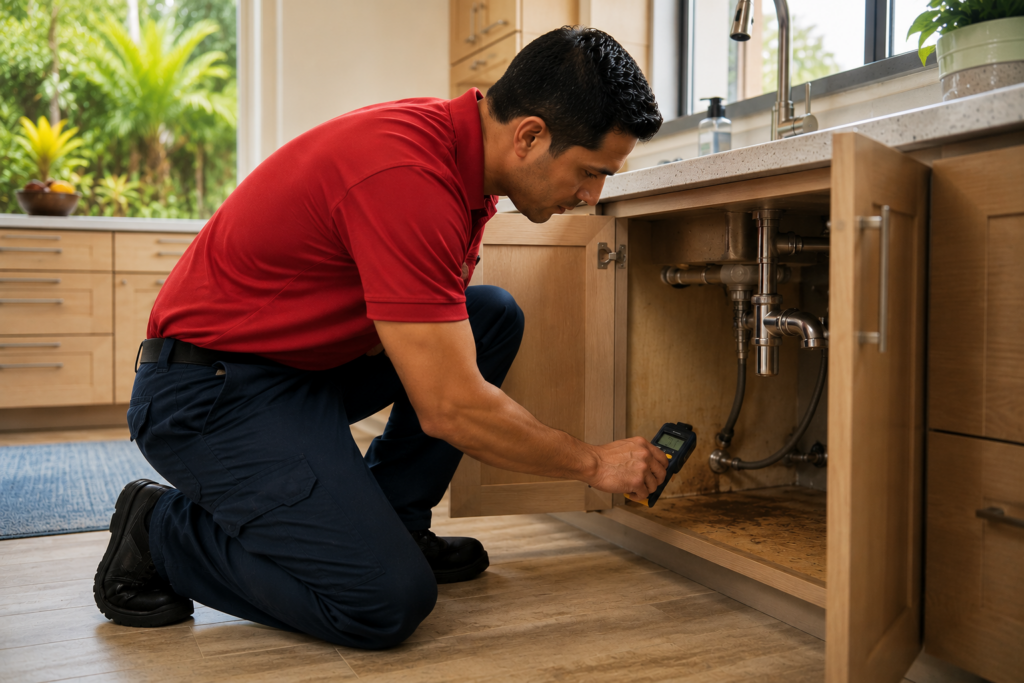
Most of the water damage we restore on Oahu did not start as an emergency. It started as something small and quiet that nobody noticed — a supply line weeping behind a dishwasher, a hairline crack in shower grout, a downspout discharging against a foundation for two rainy seasons.
The dramatic failures get the attention. A burst pipe at two in the morning is unmistakable and people call immediately. But the losses that cost the most and cause the most disruption are usually the slow ones, because by the time they announce themselves the damage has already spread into materials that now have to come out.
This is a guide to the quiet stage. What fails in Hawaii homes, what the early signs actually look like, and where the line sits between something you can handle yourself and something you should not.
Why Oahu Is a Harder Environment Than the Mainland
Every water damage prevention article ever written says roughly the same things. Most of them were written for a climate that is not ours, and the difference matters more than it sounds like it should.
Ambient humidity works against you. Relative humidity on the island runs high year-round, frequently above 70 percent and higher still on the windward side and in valleys that catch rain. Mold generally needs sustained humidity above roughly 60 percent at the material surface to establish. That means the outdoor air alone is often above the threshold. A small leak that would dry on its own in a drier climate frequently will not dry here.
The forgiveness window is shorter. On the mainland a homeowner might discover a minor leak a week later and find a dry stain. Here, a week is enough time for growth to establish on the back side of drywall.
Ventilation is not automatically the answer. Opening windows to dry a damp room in 75 percent humidity can introduce more moisture than it removes. This surprises people who moved here from somewhere with dry summers, and it is one of the more common ways a small problem gets prolonged.
Salt air degrades the things keeping water out. Coastal properties see accelerated deterioration of flashing, fasteners, sealants, and window and door hardware. The waterproofing on a house near the shore does not age the way it does inland.
Island construction behaves differently. Older single-wall construction, concrete block, and post-and-pier homes each hold and release moisture on their own terms, and none of them behave like the stick-framed slab houses most maintenance advice assumes.
The Failure Points That Actually Fail
Across the jobs we run, the same origins come up again and again. If you are going to inspect anything, inspect these.
Appliance supply lines
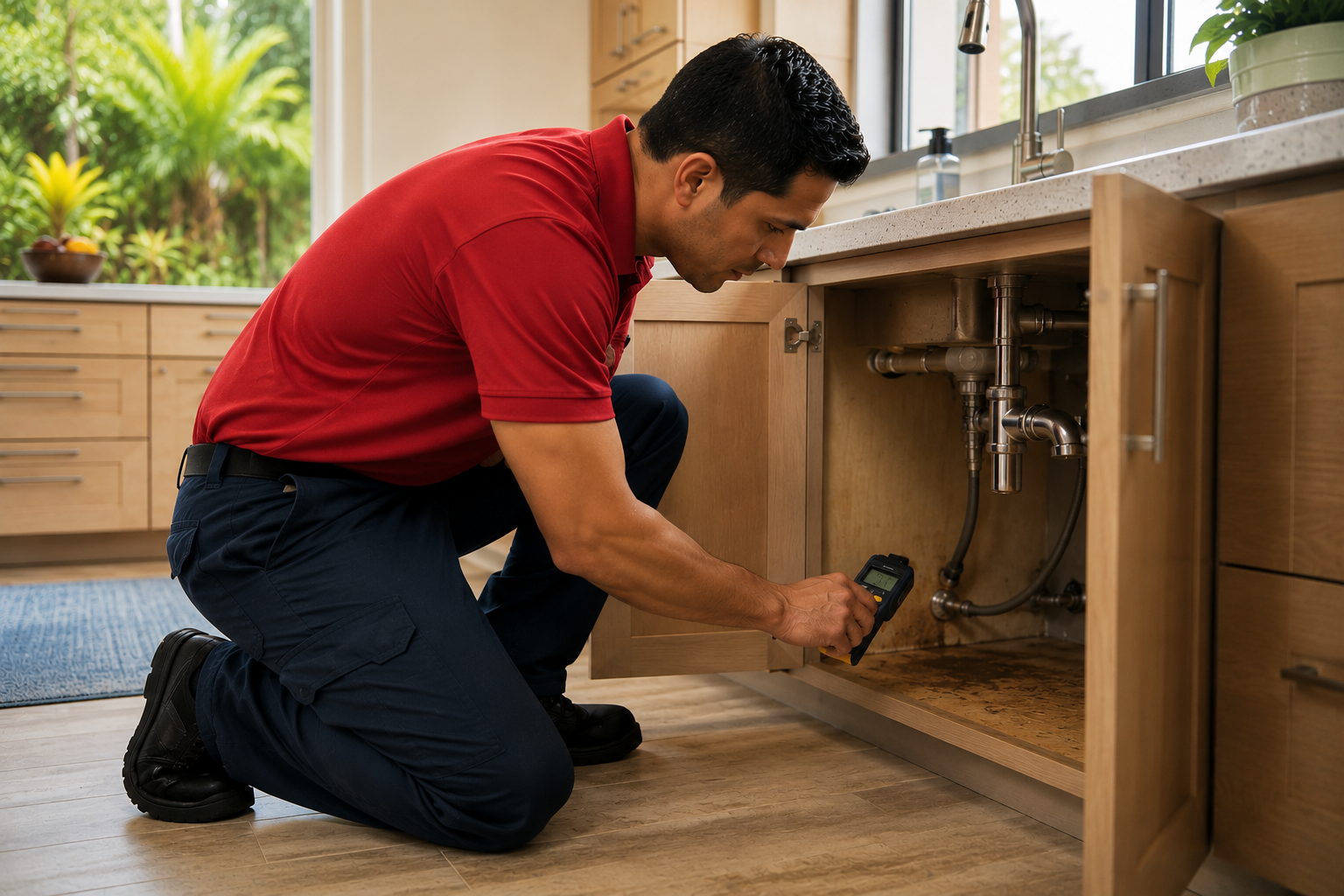
The single most common origin of significant residential water damage we see. Dishwashers, refrigerator ice makers, and washing machines are all connected to pressurized water, and the connection is almost always hidden behind or underneath the appliance.
Rubber washing machine hoses degrade from the inside and fail without warning. Braided stainless steel lines last considerably longer and cost very little. Ice maker lines are frequently the thin plastic tubing that came in the box, run through a cabinet where nothing is ever looked at.
Do this: pull the washing machine out once a year and look at the hoses. If they are rubber, replace them with braided stainless. Check the connections behind the fridge and under the sink for mineral crust or corrosion — that white or green residue means a slow weep that has been going on for a while.
Water heaters
Tank water heaters fail. Not sometimes — eventually, all of them. Most last somewhere in the range of eight to twelve years, and the failure mode is often not a dramatic rupture but a slow seep from a corroded tank that soaks whatever is underneath.
Do this: find the manufacture date on the label. If it is past ten years, you are on borrowed time. Confirm there is a drain pan underneath with a functioning drain line, particularly if the heater sits anywhere other than a garage.
Air conditioning condensate — the Hawaii-specific one
Everything above involves water arriving under pressure. This one is different, and on Oahu it may be the most overlooked failure point in the house.
An air conditioner running in island humidity pulls a significant volume of water out of the air, and all of it leaves through a condensate drain line — a narrow pipe that is easy to block. Algae, dust, and biological growth accumulate inside it, and once it clogs, the water backs up into the drain pan and then over the edge of it. Because air handlers are usually installed somewhere nobody looks — a closet, an attic, above a ceiling — the overflow can run for weeks before anything appears below.
The same principle applies to anything else in the house that condenses water: window units, dehumidifiers, chest freezers, and the drip tray behind an older refrigerator.
Do this: check the condensate drain line clears freely at least once a year, and confirm the drain pan under the air handler is dry and its secondary drain is not blocked. If you ever see water staining on a ceiling directly below an air handler, treat it as an active leak rather than an old mark.
Because HVAC ductwork also moves air between rooms, a moisture problem that starts at the air handler is one of the few that can distribute itself through the rest of the house rather than staying put.
Angle stops and toilet supply lines
The small shutoff valves under sinks and behind toilets are inexpensive parts that spend decades untouched. Toilet supply lines and wax rings are a recurring source of bathroom floor damage, and because the water goes down between the toilet flange and the subfloor, it is invisible until the floor feels soft.
Do this: look under every sink twice a year. Look for staining on the cabinet base, not just for active drips. If a toilet ever rocks slightly when you sit on it, the wax ring seal is compromised.
Grout, caulk, and shower pans
Shower grout and caulk are consumable. They crack, they shrink away from corners, and once water passes them it reaches the substrate and stays there. A shower that has been leaking through failed grout for a year does not look like anything from the bathroom side — it shows up as a stain on the ceiling below or a soft spot in the adjacent hallway.
Do this: run your eye along the corners where the wall meets the pan and where tile meets tub. Cracked or missing caulk is a twenty-minute fix now and a demolition job later.
Roof, flashing, and the building envelope
Roof leaks on Oahu tend to reveal themselves during the first sustained heavy rain after a dry stretch. Flashing around vents, skylights, and roof penetrations is usually the failure point rather than the field of the roof itself.
Do this: after heavy rain, walk your interior perimeter and look up. Check ceilings near exterior walls, look in closets on outside walls, and check the attic if you have safe access.
Drainage and grading
Gutters that overflow, downspouts that discharge against the house, and ground sloping toward the foundation instead of away from it are slow, cumulative problems that cause real structural damage over years.
Do this: watch what your gutters do during actual rain. That tells you more than looking at them dry.
Early Signs — What You Are Actually Looking For
Water damage announces itself well before it becomes obvious, but the early signals are easy to explain away.
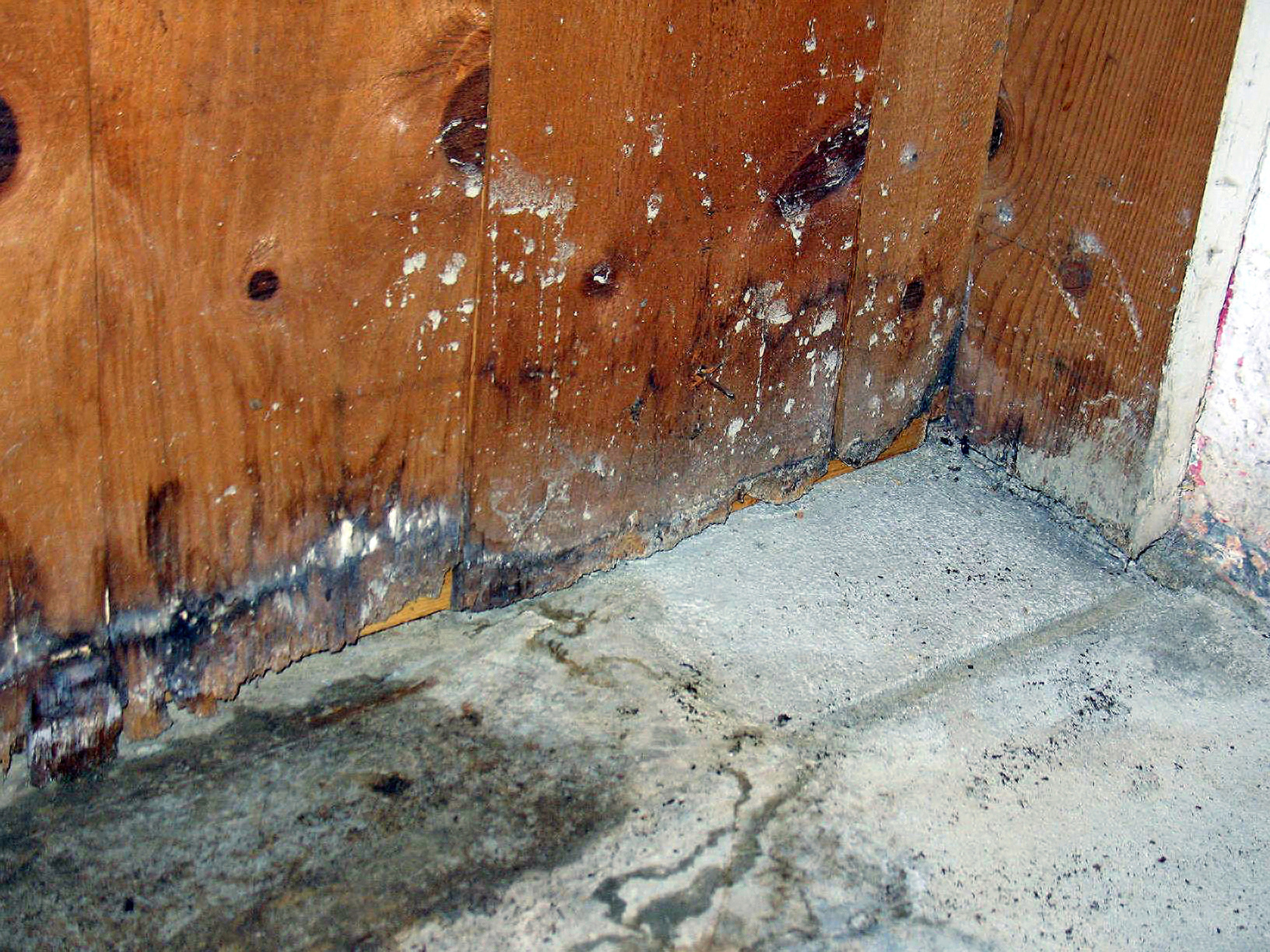
Smell comes first. A persistent musty or earthy odor in one area, particularly one that is stronger when a room has been closed up, is the most reliable early indicator there is. Your nose detects microbial growth before your eyes find it. If a room smells different from the rest of the house, take it seriously even if everything looks fine.
Staining and discoloration. Yellow or brown rings on ceilings and walls, or a patch of wall that is a slightly different shade. A stain that has a defined edge has dried at least once, which means the leak is intermittent — often rain-driven.
Paint doing something it shouldn’t. Bubbling, peeling, or blistering paint means moisture is moving through the material from behind.
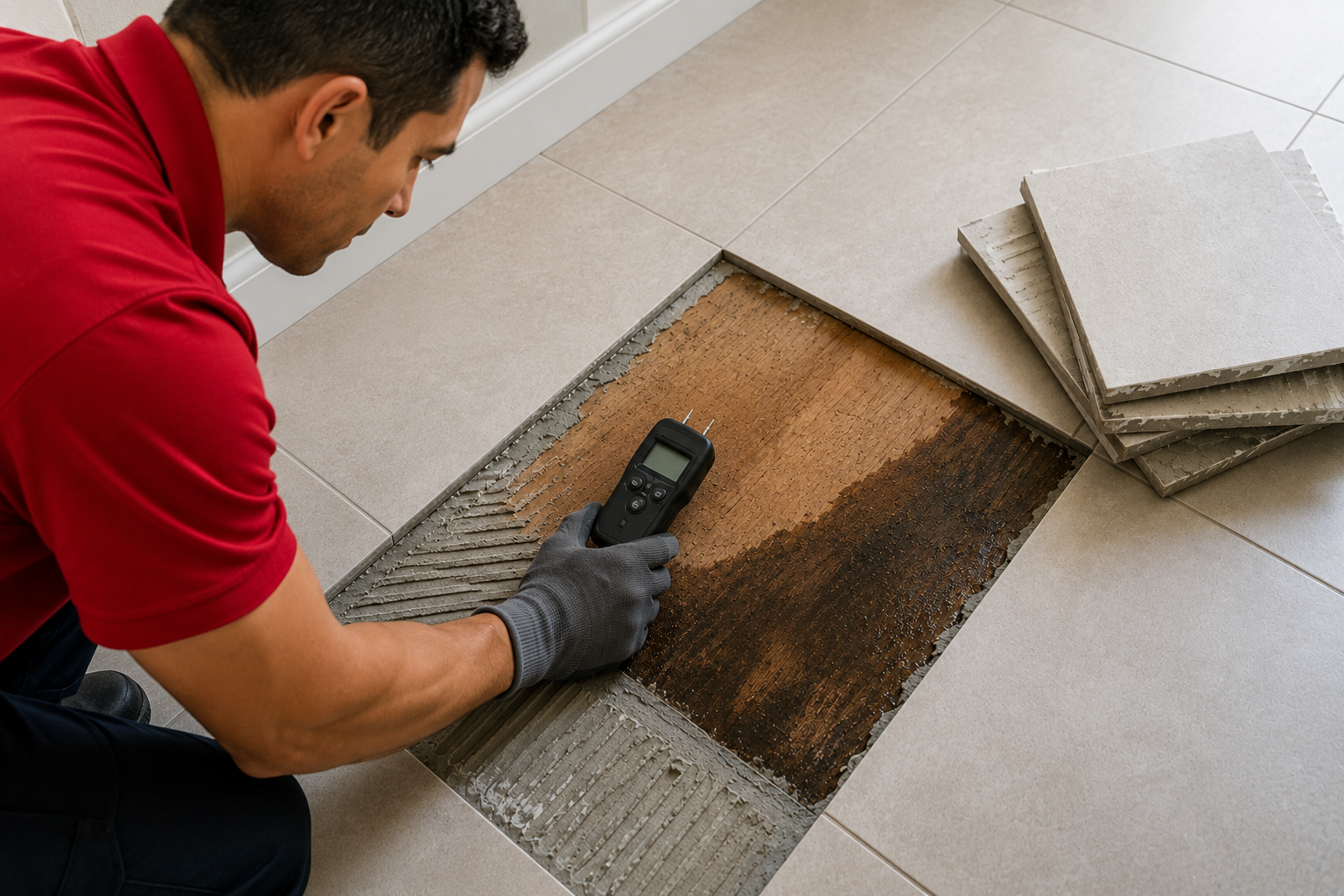
Floors that changed. Hardwood that has cupped, laminate with swollen seams, tile that has come loose or grout that has started to crack in a line, vinyl that is lifting at an edge. Soft or springy spots underfoot mean the subfloor is involved.
Visible growth. Any patch of discoloration on a wall, ceiling, or behind furniture — dark, greenish, or fuzzy. Colour tells you very little; you cannot identify a species by looking, and neither can anyone who tells you they can.
Symptoms that track with the house. If someone in the household has respiratory irritation, congestion, or worsening asthma that improves when they are away and returns when they are home, that pattern is worth paying attention to.
A water bill that moved without explanation. A meaningful increase with no change in usage means water is going somewhere. Check the meter with everything in the house off — if it is still moving, you have a leak.
Where the DIY Line Sits
We are not going to pretend everything needs a professional. Plenty of this does not.
Reasonable to handle yourself: – Replacing washing machine hoses and worn caulk – Cleaning gutters and correcting downspout discharge – Drying a small, clean-water spill promptly and completely — a glass of water, a slow drip caught the same day – Wiping a small amount of surface mold from a hard non-porous surface like sealed tile, glass, or metal, with a household product and ventilation
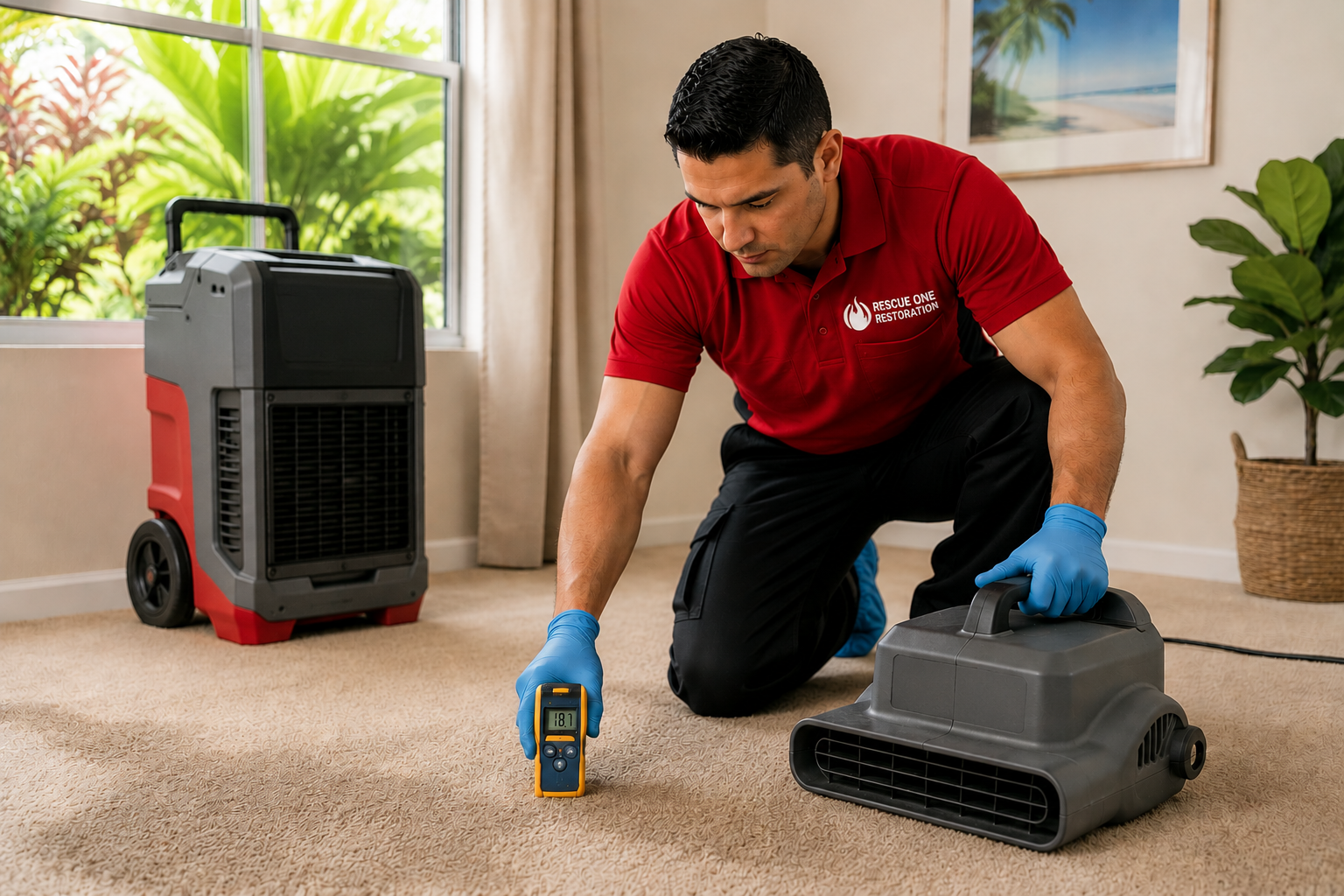
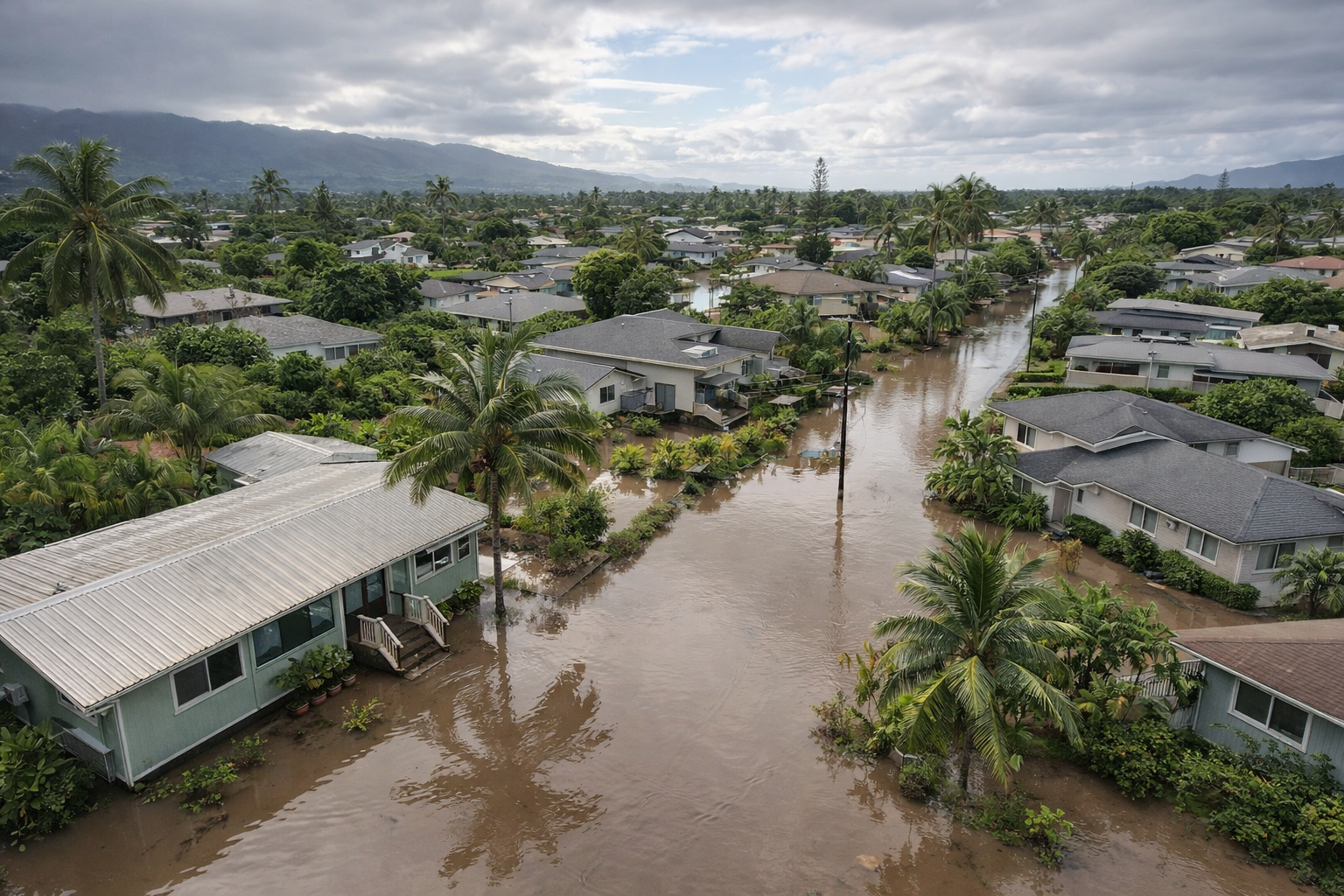
Call somebody when: – Water has contacted drywall, insulation, or subfloor. Surface drying does not address what is inside the material. – The area is larger than roughly ten square feet, which is broadly where EPA guidance stops recommending homeowner cleanup for mold. – You can smell it but cannot find it. Hidden moisture needs meters and thermal imaging, not guesswork. – The water was not clean. Anything involving sewage, drain backup, or floodwater is a contamination event, not a drying problem. – It keeps coming back. Recurrence means the source was never corrected. – Someone in the household is at higher risk — young children, elderly family members, anyone pregnant or immunocompromised, anyone with a respiratory condition.
One thing worth stating plainly: do not attack mold with bleach and a scrubbing brush. On a porous material the mold has root structures growing into the substrate. Bleach is mostly water carrying an oxidizer that reacts at the surface — the stain disappears, the organism doesn’t, and it has just been watered. Worse, scrubbing without containment aerosolizes spores and distributes them through the house and into the HVAC return. A number of the larger jobs we take on started as small ones that someone attacked with a spray bottle.
A related point on the kits sold in hardware stores. If you have found something and you want to know what it is, a retail mold test kit is a reasonable-looking next step and generally a poor one.
The problems are structural rather than a matter of buying a better brand. Most kits include no control sample and no way to regulate airflow during collection, so there is nothing to compare the result against — and since spores are present in all indoor air everywhere, a positive result is close to guaranteed regardless of whether you have a problem. Most do not distinguish dead spores from live growth, though dead spores can still provoke an allergic response. Few carry laboratory accreditation or a documented chain of custody, which is precisely why insurers and courts routinely decline to accept their results — so if the reason you are testing is a claim or a dispute with a landlord, a kit will not do the job you bought it for. And identifying a species usually requires sending samples to a laboratory at additional cost, which is not what most people understand they are buying.
There is also a practical issue: collecting samples means disturbing the growth, and disturbing growth without containment releases spores into the air you are trying to assess.
The more useful question is what you would do differently with the result. If mold is visible and you know where the water came from, the response is the same either way — remove it, find the moisture, correct it. Testing earns its cost in narrower circumstances: when a physician has asked for specific information, when a claim or a legal dispute needs documented evidence, when you can smell it but cannot find it, or when clearance verification is needed after remediation. In those cases samples should go to an independent accredited laboratory with proper chain of custody.
What Prevention Actually Buys You
Two things beyond the obvious.
Insurance treats sudden differently from gradual. Most homeowners policies respond to sudden and accidental water damage. Damage attributed to long-term seepage, or to deferred maintenance, is a common basis for reduced or denied claims. Catching a leak in week one rather than year two is not just cheaper to fix — it changes which category the loss falls into. Keeping receipts for maintenance you have done is genuinely useful if a claim is ever disputed.
Mold is almost always a moisture story with a delay. Spores are already present in every home on the island; they are inert until they land on something wet and stay there. Controlling moisture is the whole of mold prevention. Which also means that if you find mold, finding the water matters more than removing the growth — remediation without source correction is a temporary result.
If you are wondering whether something you have found is a maintenance item or a restoration job, that is a reasonable question to ask before it becomes expensive. We are IICRC certified, Hawaii licensed (BC-38891), locally owned, and have been working on Oahu homes since 2018.
Call us at (808) 745-1608 or reach us through our contact page. If you already know what you are dealing with, see our water damage restoration and mold removal and remediation services.
Two homes on the same street take on the same amount of water from the same storm. One is dry and back to normal in
Most of the water damage we restore on Oahu did not start as an emergency. It started as something small and quiet that nobody noticed
Few things unsettle a homeowner like the squish of a soaked carpet underfoot. Maybe a supply line let go overnight and you woke to a
Oahu Homeowners: What to Do Right Now After the March 2026 Storm & Flooding A Step-by-Step Guide from Your Local Oahu Restoration Team The call
Discovering water damage in your home is unsettling — the wet stain you didn’t see yesterday, the unfamiliar musty smell, the floorboard that suddenly feels

When a pipe lets go at 2 a.m. or a Kona storm pushes water across your living room floor, your first thought is how to