Water damage
24/7 Emergency Service Available. Oahu Island-Wide Service!
A sewage backup is not a bad version of a water leak. It is a different category of loss, and treating it like a water leak is how people get hurt.
The restoration industry classifies water by contamination level. Category 1 is clean water from a supply line. Category 2 carries meaningful contamination — a washing machine discharge, for instance. Category 3 is grossly contaminated water that can contain bacteria, viruses, and other harmful agents, and sewage backup sits squarely in that category. So does floodwater that has contacted ground contaminants, and so does any Category 1 or 2 loss that has been left standing long enough to degrade — which, in Hawaii’s warmth and humidity, does not take long.
What that classification changes is nearly everything about the response. Materials that would be dried in a clean-water job are removed and disposed of in a Category 3 job. Technicians work in full personal protective equipment behind sealed containment. Disposal follows different rules. And your insurance is likely to treat the loss under a different provision than you expect — often one you have to have specifically purchased.
We are IICRC certified and Hawaii licensed (BC-38891), locally owned, and operating on Oahu since 2018. If you have sewage in your home, call us at (808) 745-1608. We answer around the clock.
Water damage
What To Do Before We Arrive
The single most important thing is distance. Do not attempt to clean it yourself.
- Keep everyone out of the affected area — particularly children, elderly family members, anyone pregnant, anyone immunocompromised, and pets. Close the door if there is one.
- Do not walk through it and then walk through the rest of the house. Contaminated water spreads on shoe soles more efficiently than it spreads on its own.
- Do not run fans or air movers. In a clean-water loss, airflow helps. In a Category 3 loss, airflow aerosolizes contaminants and moves them into rooms that were not affected. This is the most common and most damaging mistake we see.
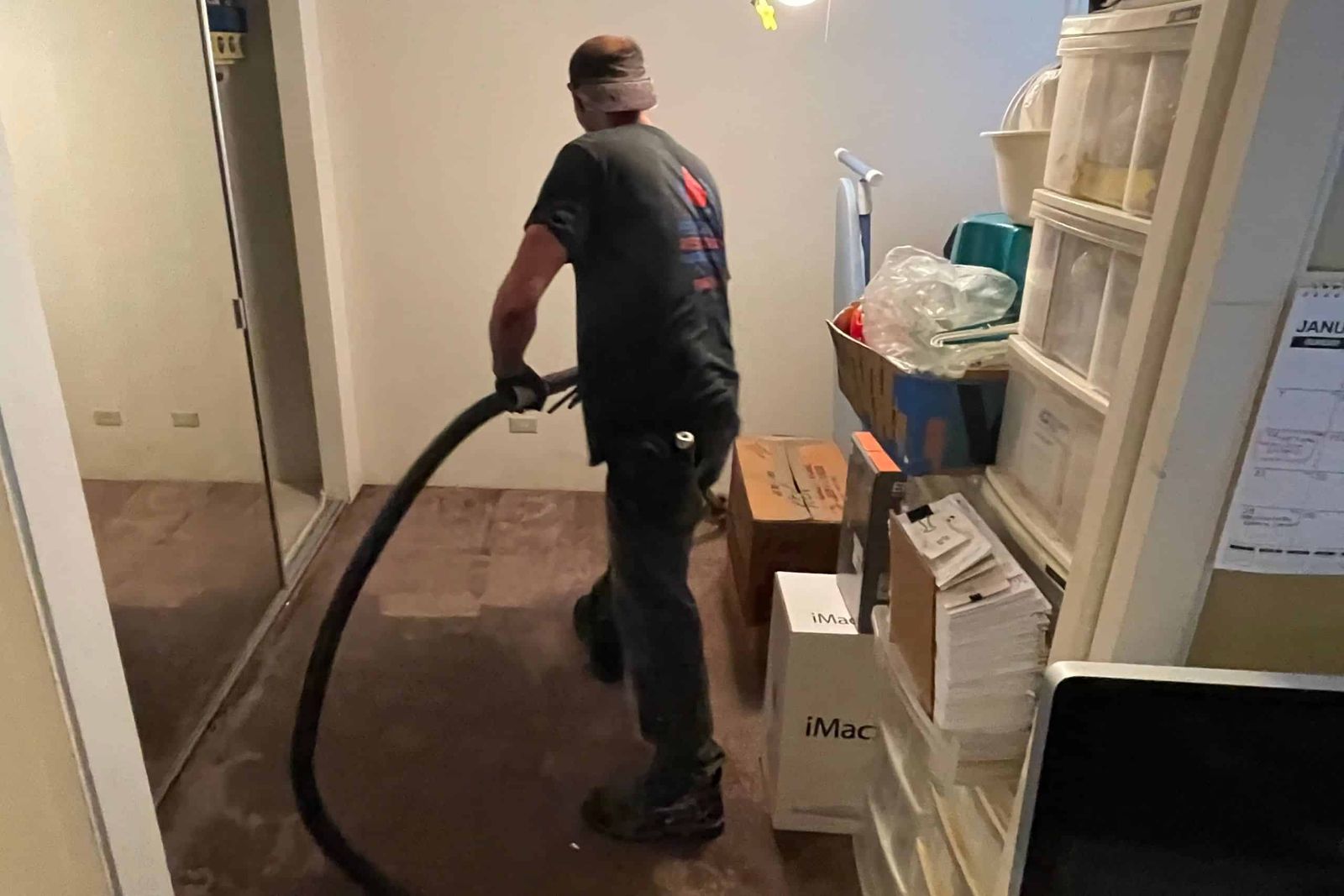
- Do not use household bleach or a wet vacuum. Bleach does not address contamination inside porous materials, and a consumer wet vac has no containment, no filtration, and no way to be decontaminated afterward.
- Stop water use in the building if the backup is coming through a drain or fixture — every flush, sink, and shower adds to the volume.
- Turn off power to the affected area at the breaker if you can do so without stepping into the water. If you cannot, leave it and tell us when we arrive.
Photograph what you can safely photograph from the doorway. Then wait for us.
Water damage
Why Sewage Backups Happen on Oahu
The causes we encounter most often on the island:
- Main line blockages from tree root intrusion, grease accumulation, or collapsed and aging clay lateral lines — common in older Honolulu neighborhoods where the sewer laterals date to the original construction.
- Municipal system surcharge during heavy rain. When the public system takes on more volume than it can carry, the pressure has to go somewhere, and in a home without a backwater valve it goes up the lowest fixture. Ground-floor bathrooms, laundry rooms, and floor drains are where it shows up.
- Failed or absent backwater valves, which is why the same properties tend to flood repeatedly.
- Lift station and pump failures in low-lying and coastal areas.
- Blocked or collapsed private laterals, which are the homeowner’s responsibility rather than the county’s — a distinction that matters a great deal when the bill arrives.
Understanding which of these caused your backup is not academic. It determines who is liable, what your policy will and will not respond to, and whether the problem will recur next storm season. We identify the cause as part of the assessment and document it.
How it works
Our Category 3 Remediation Process
Assessment and hazard identification
We assess the extent of contamination, identify the source, and determine how far the water travelled — including into wall cavities and under flooring where it is not visible. We check for electrical hazards and for structural concerns before anyone begins work. Our site assessment carries a fee, credited toward your job total if you proceed with us.
Containment before anything is touched
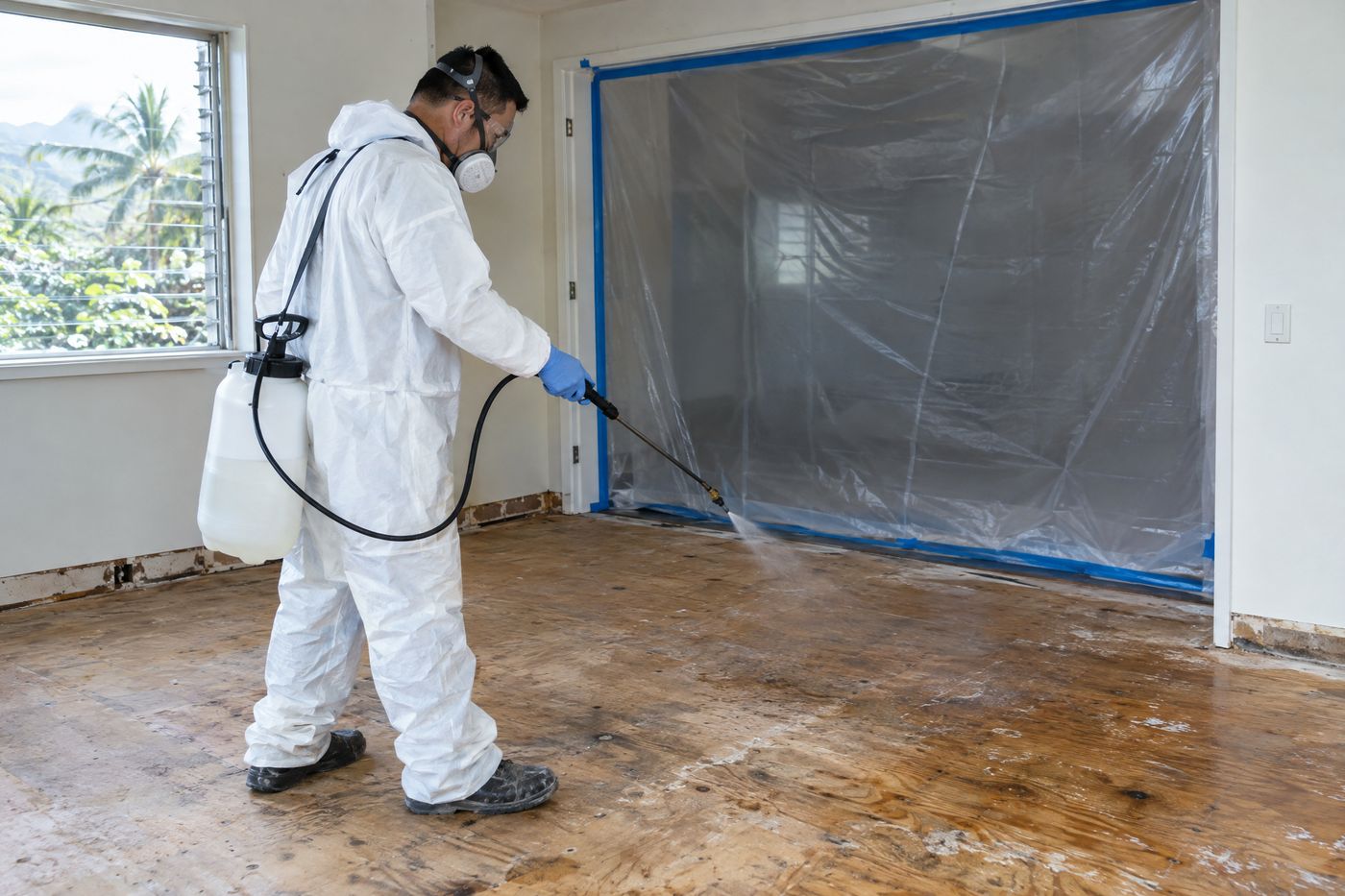
Affected areas are sealed with polyethylene barriers and placed under negative air pressure using HEPA air scrubbers, so that air flows into the contained area and out through filtration rather than into your living space. Doorways, returns, and supply vents in the affected zone are sealed. In a clean-water job, containment is sometimes optional. Here it is not.
Personal protective equipment
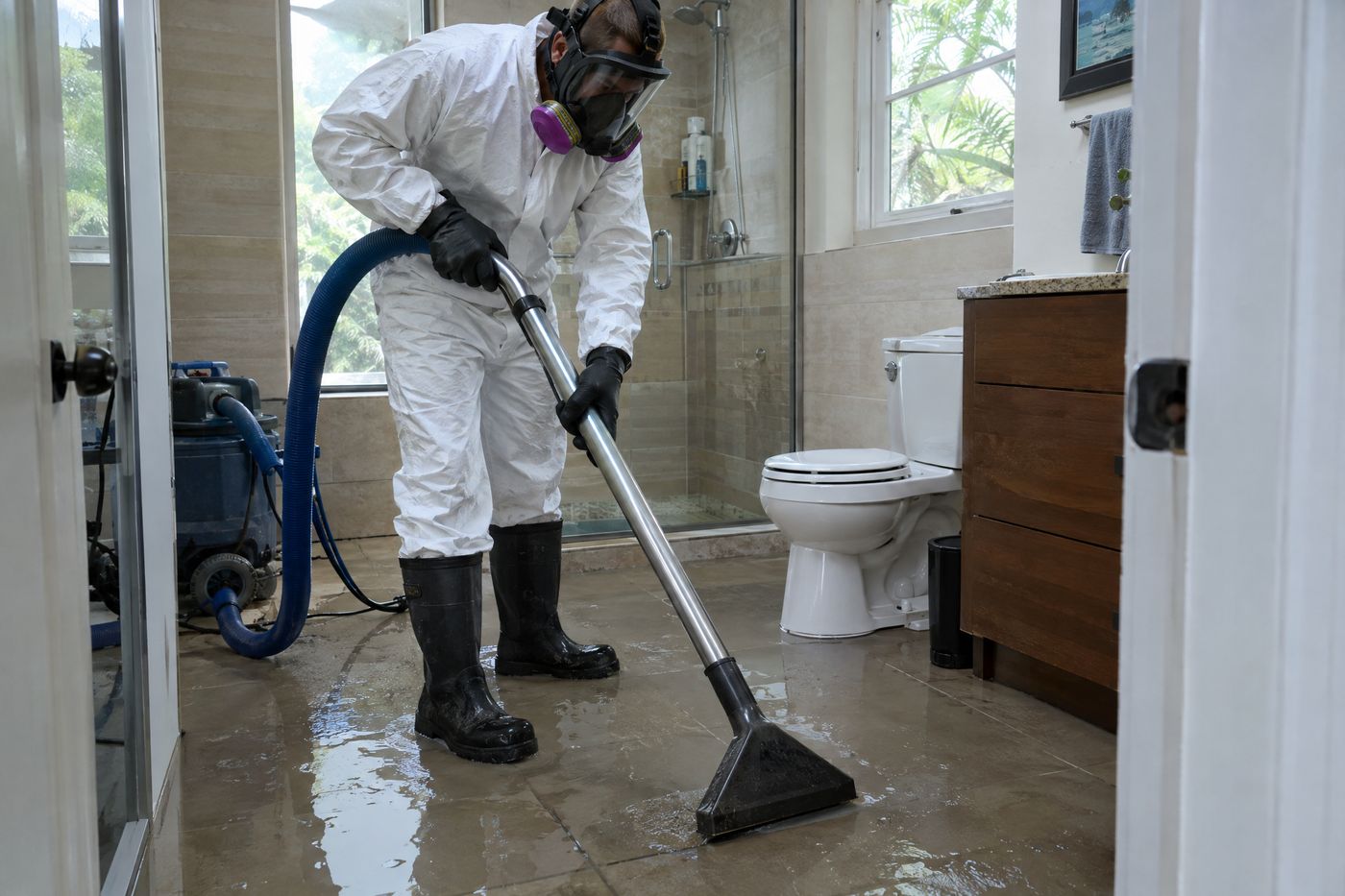
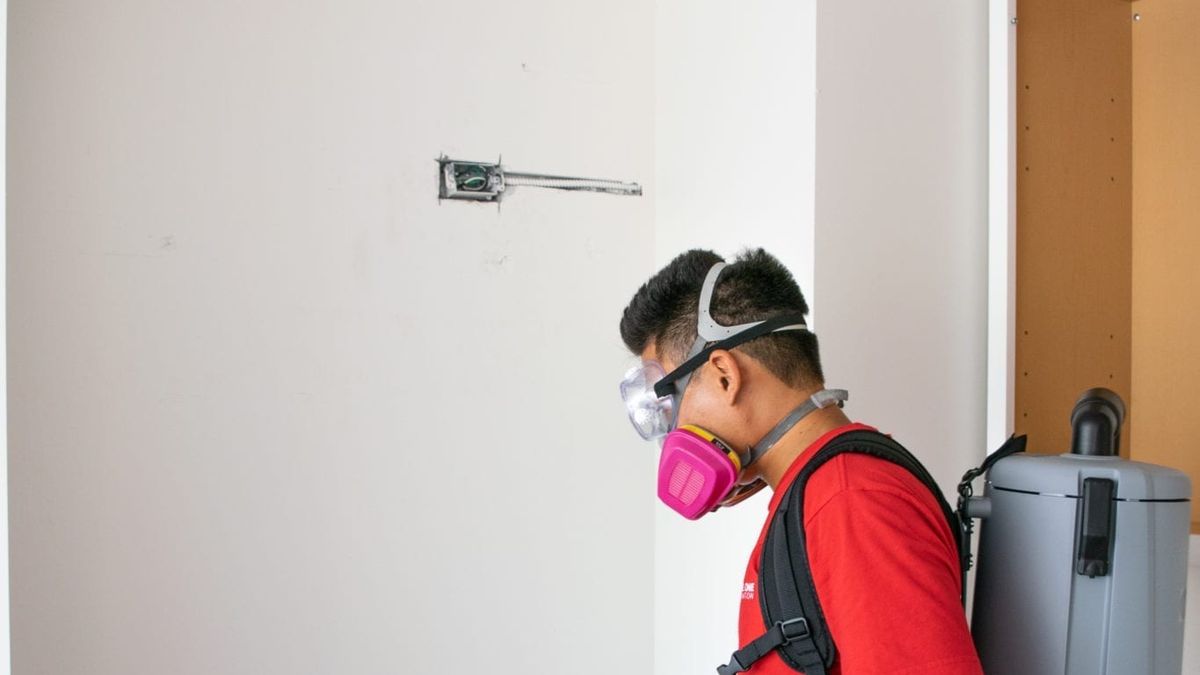
Our technicians work in full PPE appropriate to Category 3 conditions — respiratory protection, eye protection, impermeable suits, gloves, and boots — with a defined decontamination sequence when leaving the containment. This is not theatre. It is the reason our crews can work in these conditions safely and the reason contamination stays inside the barrier.
Extraction and gross debris removal
Contaminated water and solids are extracted using dedicated equipment that is decontaminated afterward and never crosses over to clean-water work.
Removal of porous materials
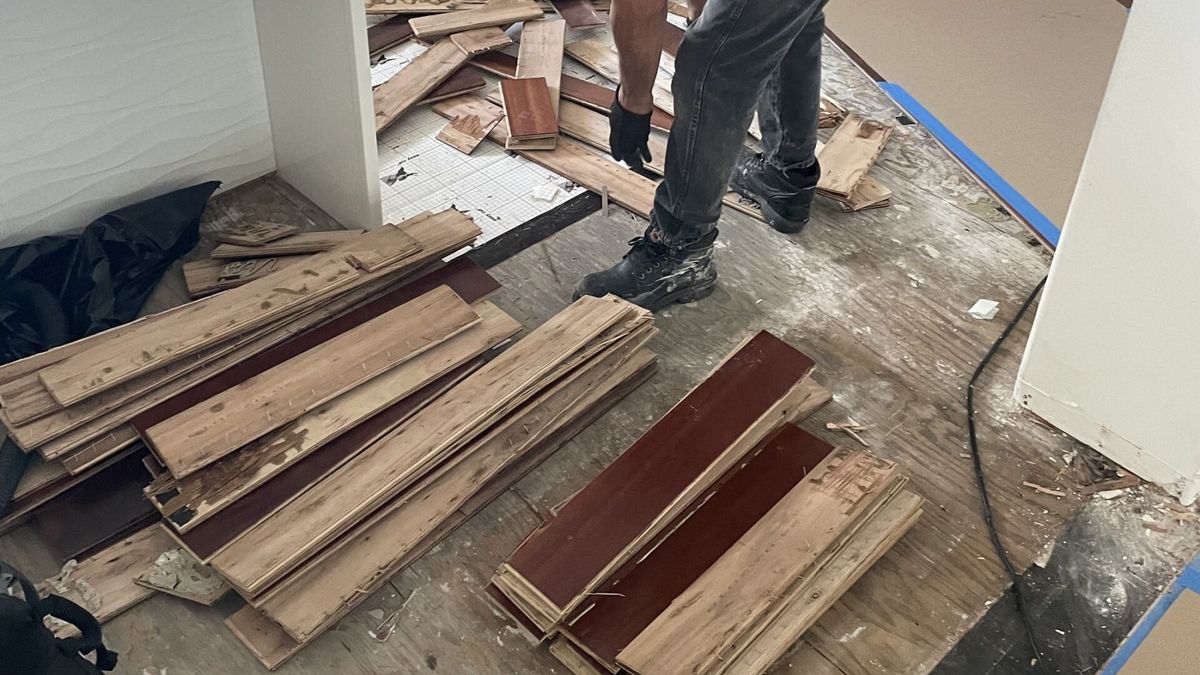
This is the step that most distinguishes a sewage job from a water damage job. Porous and semi-porous materials that have absorbed Category 3 water are generally removed rather than dried:
- Carpet and carpet padding
- Drywall, typically cut back well above the visible contamination line
- Insulation, in all cases
- Particleboard and MDF cabinetry and furniture
- Ceiling tiles, laminate flooring, and engineered wood
- Upholstered furniture and mattresses that were contacted
These materials cannot be reliably decontaminated. Drying them leaves contamination inside the material, which is how a “cleaned up” sewage loss becomes an odor problem and a health problem three weeks later. We bag and dispose of removed materials in accordance with disposal requirements, and we document every item for your claim.
Non-porous and semi-porous materials that can be reliably cleaned — concrete, tile, metal, sealed hardwood in some conditions, structural framing — are cleaned rather than removed wherever that is the right call.
Cleaning and antimicrobial application
All contacted surfaces are cleaned and then treated with EPA-registered antimicrobial products appropriate to the material. Application follows the product’s required contact time; wiping a disinfectant on and immediately off does very little.
Structural drying
Only once contamination has been removed do we dry the structure, using the same commercial equipment and meter-verified endpoint as our water damage restoration work. Drying a contaminated structure before decontaminating it drives contamination deeper into the material.
Verification, then reconstruction
We verify the work before we call it finished, and we document the verification. Where materials were removed, we handle the rebuild ourselves through our full reconstruction service — same license, same contract, same team.
Water damage
Health Risks, Stated Plainly
Sewage carries bacteria, viruses, parasites, and fungi. Exposure routes are contact with skin or mucous membranes, ingestion via contaminated hands or surfaces, and inhalation of aerosolized droplets — which is why running a fan across it is genuinely counterproductive.
Reported effects range from gastrointestinal illness and skin infections to respiratory irritation. Risk is higher for young children, older adults, pregnant women, and anyone immunocompromised or with existing respiratory conditions. Household members in these groups should stay out of the affected area entirely until remediation is verified complete.
We are not going to tell you that a sewage backup is a medical emergency, because for most healthy adults with brief incidental contact it is not. We will tell you that it is a genuine contamination event that should be handled by people with the containment and protective equipment to handle it, and that the risk is real enough not to improvise. If anyone in your household develops symptoms after exposure, contact a physician.
Water damage
Insurance: Read This Part Carefully
Sewage backup is one of the most common gaps in Hawaii homeowners’ coverage, and we would rather you learn it from us now than from your adjuster later.
A standard HO-3 policy frequently does not cover water that backs up through sewers or drains. Coverage for this specific peril is usually offered as a separate endorsement — commonly called water backup or sewer backup coverage — that has to be added to the policy, often with its own sub-limit well below your dwelling limit. Many homeowners assume they have it and do not.
Separately: if the backup was caused by surface flooding rather than a drain or sewer failure, that falls under flood coverage, which in Hawaii means a separate NFIP or private flood policy. Standard homeowners policies do not cover flood.
We are not able to tell you what your policy covers — only your policy and your carrier can do that, and we will not guess at it. What we can do is document the loss thoroughly enough that the claim is decided on the facts: photographs, moisture readings, source identification, a full inventory of materials removed, and a written scope of work prepared in the format adjusters expect. We coordinate directly with your adjuster and can be present for the inspection. For general background, see our guide to insurance coverage for damage restoration in Hawaii.
If the loss is not covered, we will tell you that plainly and give you a written scope so you can make a decision with real numbers in front of you.
Water damage
Mold Is the Follow-On Risk
A sewage backup introduces both contamination and moisture, and in Oahu’s humidity the moisture becomes a mold problem quickly if the structure is not dried properly. Removing porous materials and drying to a verified endpoint is what prevents that. Where mold has already established before we arrive — which happens when a slow backup goes unnoticed behind a wall — we handle it through our mold removal and remediation services under the same contract.
Reviews
What Our Customers Are Saying
When we had urgent moisture remediation service need Rescue One Restoration came to the rescue! I can’t say enough positive things about the company’s professionalism, especially from the team lead, Aaron.
When I first reached out, on a weekend, Aaron adjusted his personal schedule to come out and take a look at the issue that same day. Once work began, their work was high-quality and every team member was very professional, which was especially important to us as we are a school that had students and staff present on campus at times. Aaron did a wonderful job of being on-site daily, overseeing the project from start to finish, and keeping our administrative team updated every step of the way. Highly recommend!
We have worked extensively with Rescue One on many of the projects we manage and they are our "Go To". Paul is awesome on his communication, response and knowledge of how insurance works.
5 Stars.
Had the basement in our office flooded because of the storm, but these guys were such a HUGE HELP especially shout out to Amen and Chozyn for helping to get all the water out of the basement carefully and diligently as well as being warm, courteous and professional young adults!
During the March storms, our house took a beating. I called other places but they were all busy.
I was very lucky to have Rescue One come out to the home very quickly and leave machines to dry out the house. JJ was on top of it.
Excellent and timely service – would definitely use them again! Paul was very responsive and assisted us in our time of need.
Mahalo!
Paul and his team were professional, communicated well, worked with other contractors under strict time constraints. They were helpful & efficient in both the assessment and repair of damage.
Highly recommend.
Frequently asked questions
Frequently Asked Questions About Sewage Backup Cleanup
Don’t see your question? Call us anytime.
01What makes a sewage backup different from ordinary water damage?
The contamination category. The restoration industry sorts water into three categories: Category 1 is clean water from a supply line, Category 2 carries meaningful contamination, and Category 3 is grossly contaminated water that can carry bacteria and viruses. Sewage is Category 3. That changes the whole response: sealed containment, full protective equipment, and removal of materials that a clean-water job would simply dry.
02What can be cleaned and kept after a sewage backup?
Non-porous and some semi-porous materials can usually be cleaned and kept: concrete, tile, metal, structural framing and, in some conditions, sealed hardwood. Porous materials that absorbed the water generally have to go, including carpet and padding, insulation, drywall cut back above the waterline, particleboard cabinets, and upholstered furniture or mattresses that were touched. We document every removed item for your claim.
03Why shouldn’t we run fans to dry the room out?
In a clean-water loss, airflow helps. In a sewage loss, it blows contaminated droplets into the air and carries them into rooms that were not affected, which is the most common and most damaging mistake we see. Drying comes last in our process, after contaminated materials are removed and surfaces are cleaned and treated, because drying first drives contamination deeper into the material.
04Who in the household should stay out of the affected area?
Everyone, ideally, but especially young children, older adults, anyone pregnant, anyone immunocompromised or with a respiratory condition, and pets. They should stay out until the work is verified complete. For most healthy adults, brief incidental contact is not a medical emergency, but it is a real contamination event. If anyone develops symptoms after exposure, contact a physician.
05Can we keep using the toilets and sinks while we wait?
Not if the backup is coming up through a drain or fixture. Every flush, sink and shower adds to the volume, so stop water use in the building until the cause is found. Do not walk through the affected area and then through the rest of the house, and turn off power to that area at the breaker only if you can reach it without stepping into the water.
24/7 emergency response
Call Us
Sewage backup is the one category of water loss where waiting is worst and where do-it-yourself is genuinely a bad idea. Every hour the contamination sits, it moves further into materials that then have to come out.
We are locally owned, IICRC certified, and licensed in Hawaii (BC-38891). We answer 24 hours a day, seven days a week, and you reach a member of our team rather than a message service.
Call (808) 745-1608, or reach us through our contact page. Tell us what you are seeing and where, and we will tell you what to do until we get there.
Restore Your Home, Recover Your Life.
24/7 emergencyAll of OahuIICRC certifiedLic. BC-38891Locally owned & operated