Commercial restoration
When a pipe fails in a house, one household has a hard week. When it fails in an office, a restaurant or a condo tower, the loss reaches people who never touched the plumbing: tenants who need to open tomorrow, staff who need somewhere to work, guests who already booked, and owners on several floors who each want an answer. That is the difference this page is about. The drying, cleaning and rebuilding are the same trades as on a home. Who has to keep running, who has to be told, and who has to approve the work are not.
Rescue One Restoration takes commercial jobs across Oahu: offices, retail, restaurants, hotels, condo common areas and AOAO buildings, rental portfolios, warehouses, schools and churches. We have worked on the island since 2018, we are IICRC certified, and our Hawaii contractor license, BC-38891, covers the commercial work we do. The emergency line, (808) 745-1608, is answered 24/7 by a real person.
This page is for whoever makes decisions for a building other people rely on: an owner, a property manager, a facilities director or a board member. It covers the properties we work in and what each needs first, how scheduling is planned around your operations, which services apply, how documentation is put together for a commercial policy, and the vendor paperwork a manager or board usually asks for. If the loss is in your own home, our residential water damage restoration page is the better place to start.
Commercial restoration
Commercial Properties We Work In, and What Each One Needs First
Every commercial loss has a group of people behind the building, and the first question on the walkthrough is who they are and what they need to keep doing. The answer changes with the property type more than with the cause of the water.
Offices and Retail
In an office the pressure is on the work that cannot stop: phones, servers, files, the front desk. In retail it is the sales floor and the stock on it. In a leased space two parties usually have a stake in the same wet wall, the landlord in the building and the tenant in what they built out or brought in. We ask early who authorizes which part of the work, so drying is not held up while the lease gets read.
Restaurants and Food Service
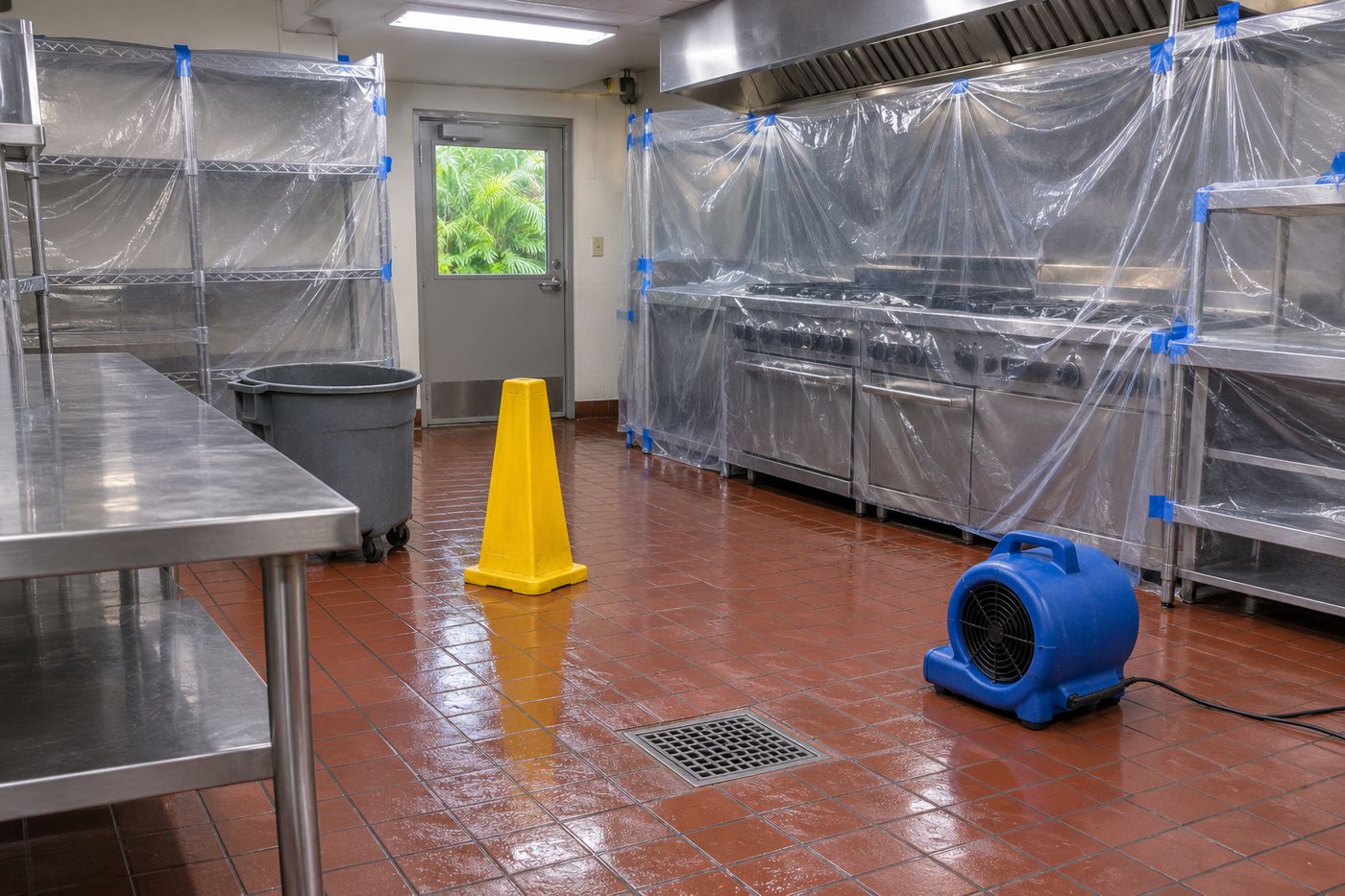
A kitchen loss carries a rule a home never does. Hawaii food safety rules (HAR chapter 11-50) require a food establishment to stop food operations and notify the Department of Health when an emergency such as a flood or a sewage backup may create an imminent health hazard, and to get the department’s approval before resuming. An area the hazard does not affect may be allowed to keep operating. Reopening is the department’s decision, not ours. Our part is to clean the affected areas properly and leave you a written record of what was done, where and when.
Hotels
For a hotel, every wet room is a room that cannot be sold, and water in a stacked building tends to follow the shared plumbing down through the rooms below. Guests are often still in the rooms next door. Whether the rooms beside the work can stay in service is decided with your operations team on each job, based on where the water went and what the drying equipment needs.
Condo Towers and AOAO Buildings
A leak in a high-rise rarely stays in one unit. It crosses floors, shows up in ceilings two units down and runs through common-element walls on the way, the pattern our page on water coming through a ceiling from the unit above describes from the owner’s side. On the building’s side it means access to several units, several owners and their insurers, and a board that wants one account of where the water started. Who is responsible for which part is a separate question, covered in our guide to water damage by property type.
Under Hawaii’s condominium law, HRS section 514B-143, the association carries property insurance on the common elements unless the declaration or bylaws provide otherwise. Check your declaration and the master policy for how your building divides it; we work to whatever those documents say.
Rental Portfolios
An owner or manager with several rentals needs the same thing on every property: one contact, the same format of photos and moisture records on each unit, and a clear note of which tenant was told what and when. Keeping the files consistent across properties makes them easier to compare and easier to send on.
Warehouses
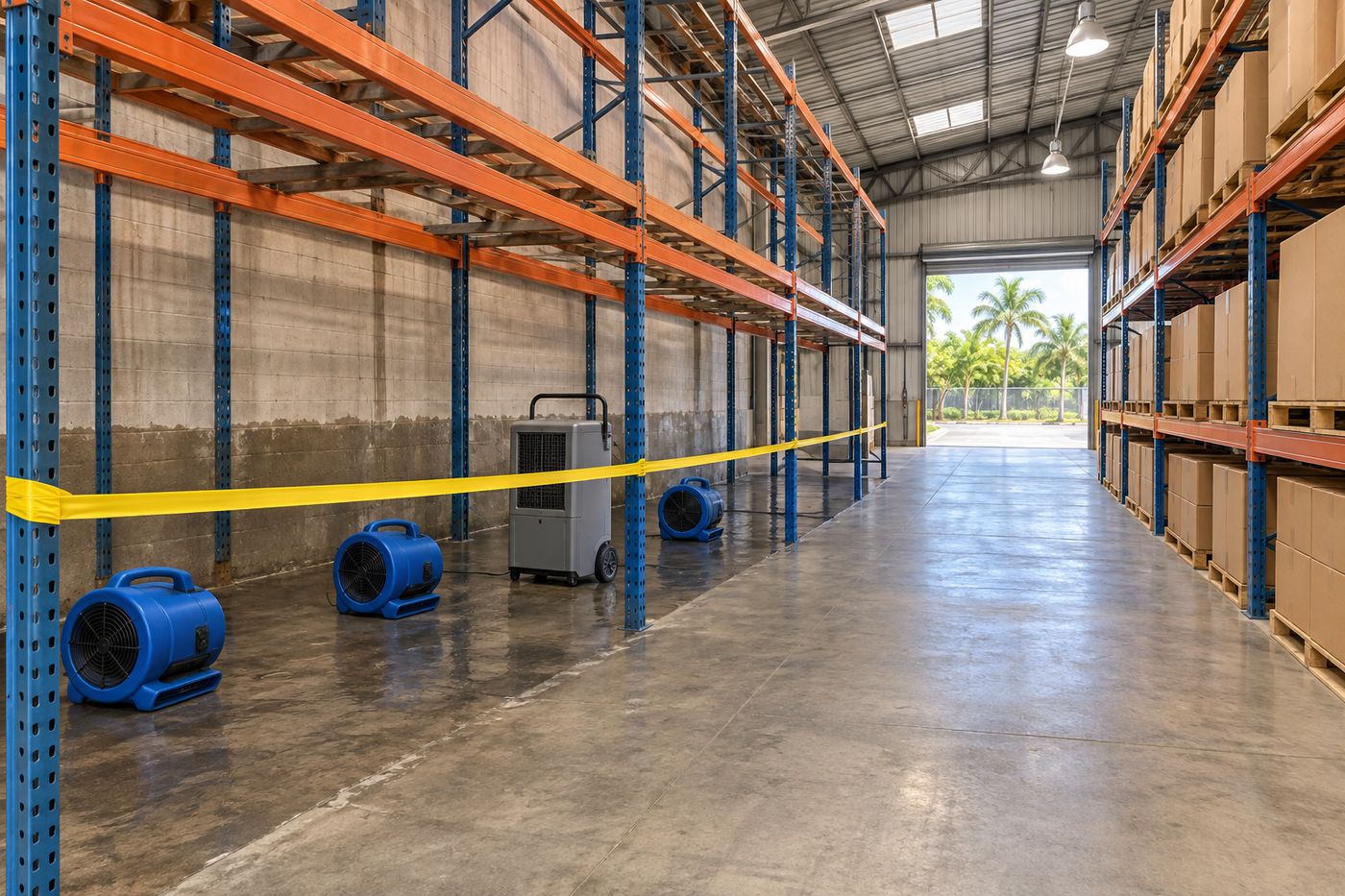
In a warehouse the building is often the smaller part of the loss. Stock on pallets and racking takes water from the slab up, and the contents claim depends on knowing what was on which rack and how high the water reached. We photograph and log affected inventory by location before anything is moved, and plan the work around the aisles and docks you need to keep using.
Schools and Churches
Schools and churches run on a calendar: a term, a weekly service, a funeral or a graduation already booked in the hall. The spaces are used by people who are not the decision makers, including children, and approval usually comes through an administrator, a facilities committee or a council. We plan around the dates that cannot move and keep the person who answers to that group informed.
Commercial restoration
Keeping Your Business Running While the Work Happens
The first conversation on a commercial job is about your operations, not our equipment: what has to stay open, which hours are busiest, which areas can be closed off, and who still needs to get through the building. Scheduling is then planned case by case around those answers. Timing outside your open hours, or splitting the work into stages so part of the space keeps running, is something we decide with you on each job, because whether it works depends on the building and the loss.
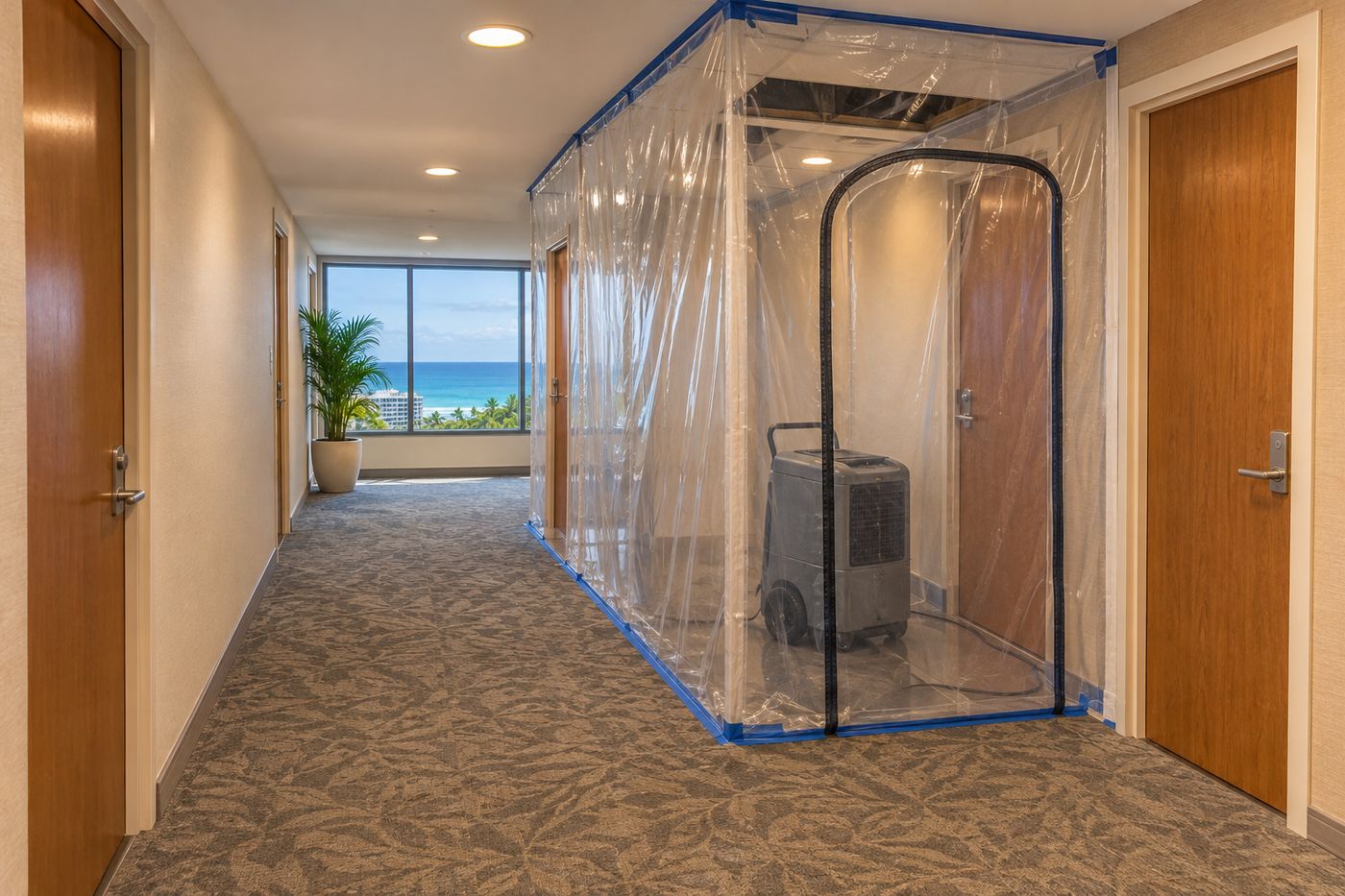
Drying equipment runs around the clock and needs power and floor space, so we tell you on the walkthrough what it needs and where it will sit. Areas under work are closed off from the people still using the building. If tenants, staff or guests need a notice, we give you the plain facts for it: which area, what is happening, and who to ask.
Some losses can be worked around a running business and some cannot. We say which on the walkthrough, rather than promise a schedule the building cannot support.
Commercial restoration
Restoration Services for Commercial Properties
Every service we offer applies to commercial buildings. Each has its own page on how the work is done; what follows is what changes when the building is a business.
Water Damage
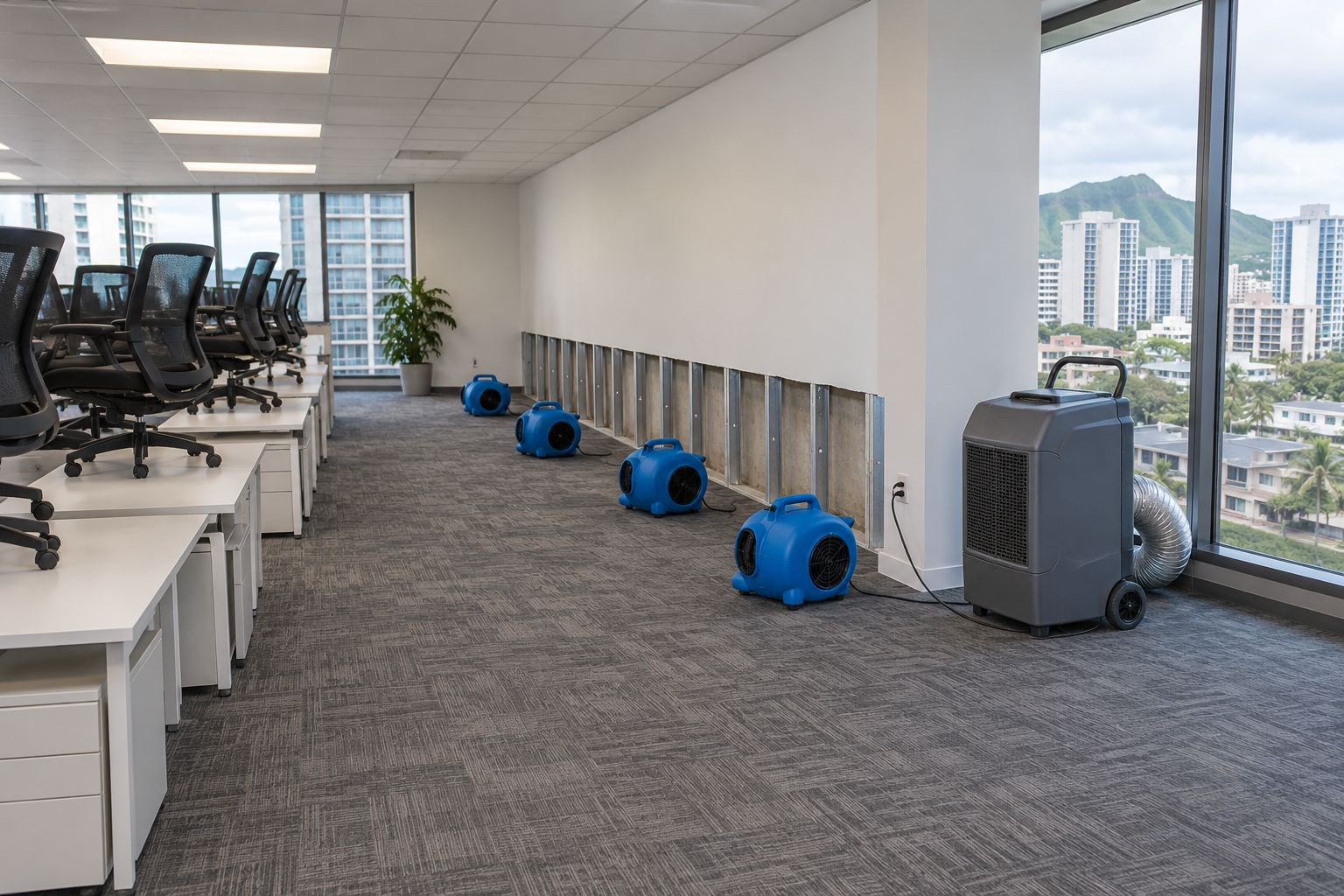
Commercial water losses often start somewhere a homeowner never deals with: a roof drain, a cooling-tower line, a fire sprinkler head, a shared riser. The water travels under partition walls into the next suite and through slab penetrations to the floor below, so the first job is finding the edge of it. A moisture inspection maps that edge, and extraction and structural drying follow.
Mold
For commercial mold remediation on Oahu, the method is the same as anywhere. What changes is who has to be told, how the work area is kept apart from people working nearby, and whether shared air handling serves the affected space. The EPA’s mold remediation guide for schools and commercial buildings is written for building managers and is worth reading alongside our scope.
Fire and Smoke
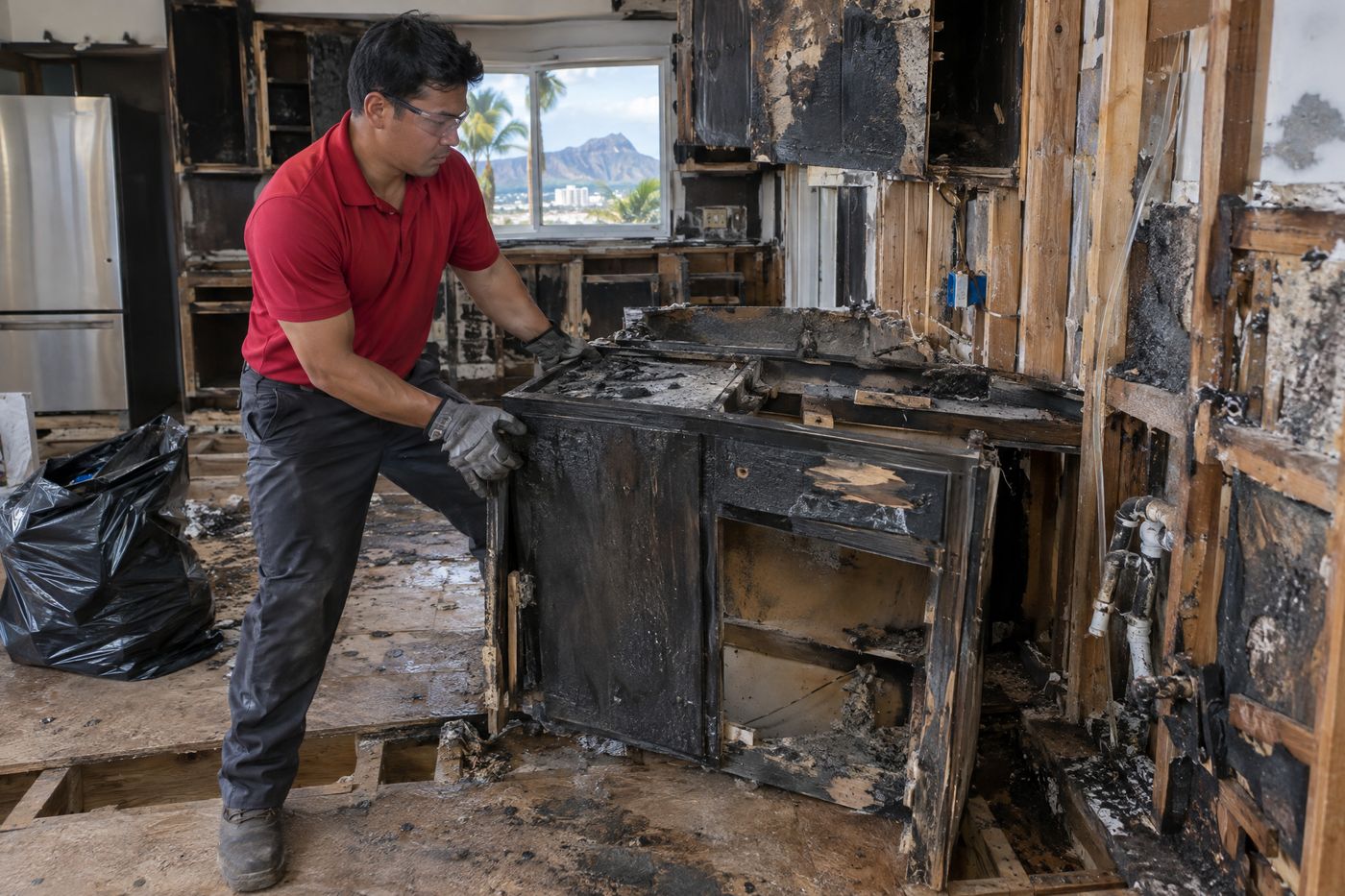
In a commercial building smoke travels through ceiling plenums and ductwork into suites the fire never reached, which turns one tenant’s loss into several. Our fire damage restoration and smoke odor removal pages explain the work; on a commercial job we also record which suites were affected and how, because each tenant may claim separately.
Sewage
A backup in a public restroom, a restaurant kitchen or a shared stack in a condo building affects people who had no part in causing it. Sewage backup cleanup is done to the same standard in a commercial space, with the affected areas closed to occupants until the work is complete and, for food service, the record you need for the department.
Storm and Flood
After a storm, a commercial property may have an open storefront, a flooded ground floor and tenants upstairs who still need to get in. Emergency board-up and roof tarping closes the building first, and storm and flooding restoration or flood damage cleanup follows.
Reconstruction
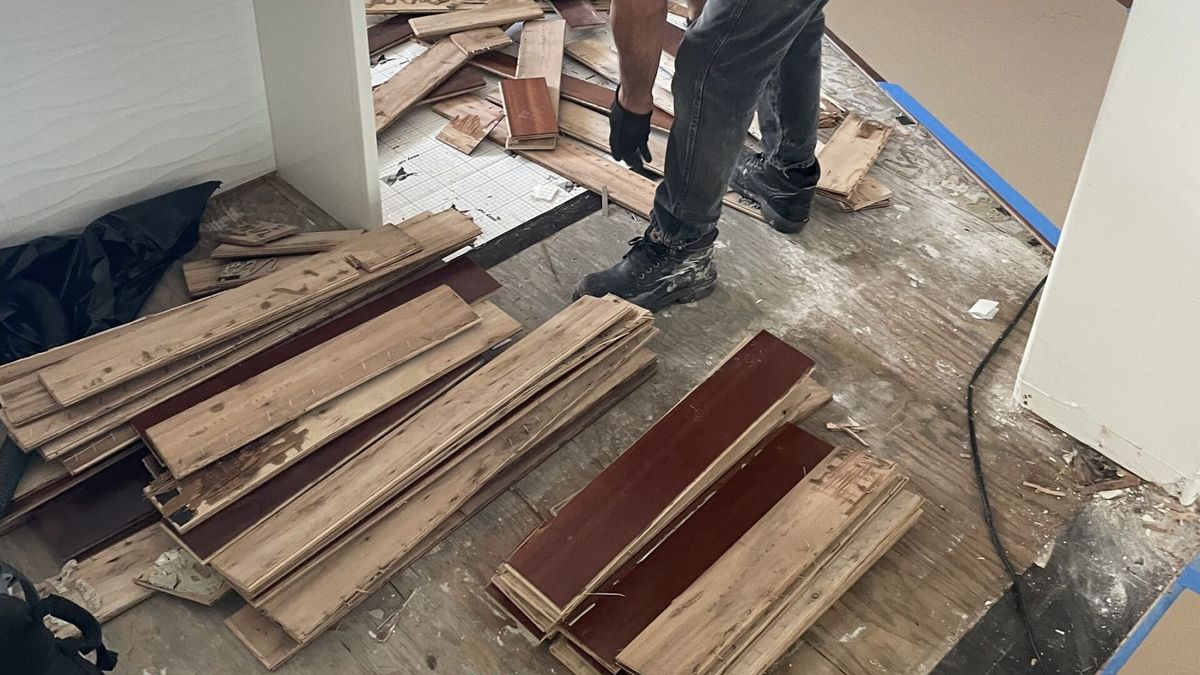
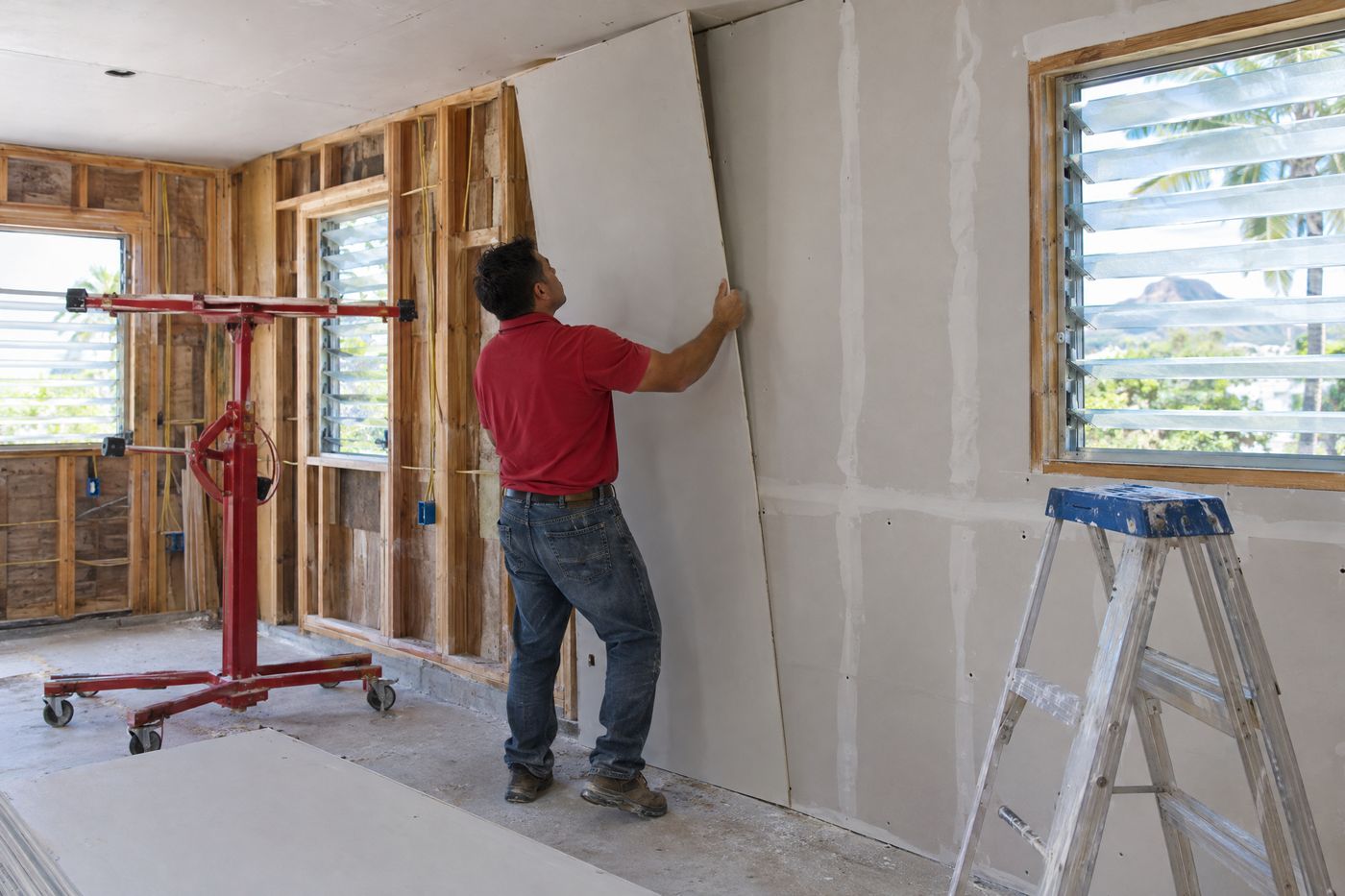
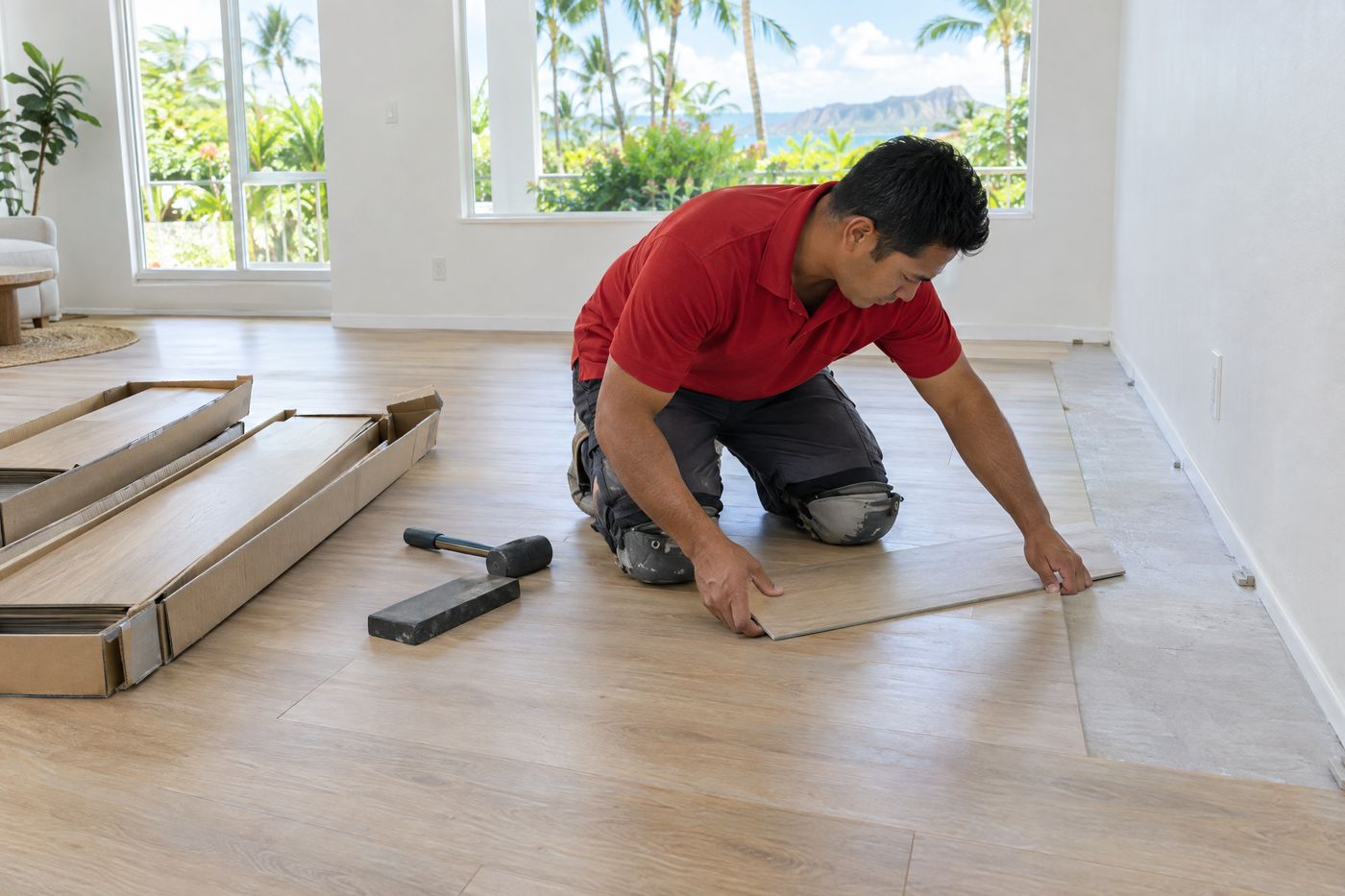
When drying and cleaning are done, the space still has to be put back so a business can use it: walls, floors, ceilings and finishes. Our full reconstruction service carries the same file and the same contact from the emergency through to the rebuild, so the manager is not briefing a second contractor from scratch.
Commercial restoration
Insurance and Documentation for Commercial Policies
We bill commercial carriers directly, and we work with public adjusters and third-party administrators as well as the carrier’s own adjuster. Whoever is handling your claim gets the documentation in the form a commercial file needs.
- Photographs of each affected area, before and during the work, labeled by suite, unit or room
- Moisture readings logged by location and date until the structure reads dry
- Emergency mitigation scoped and invoiced separately from repairs
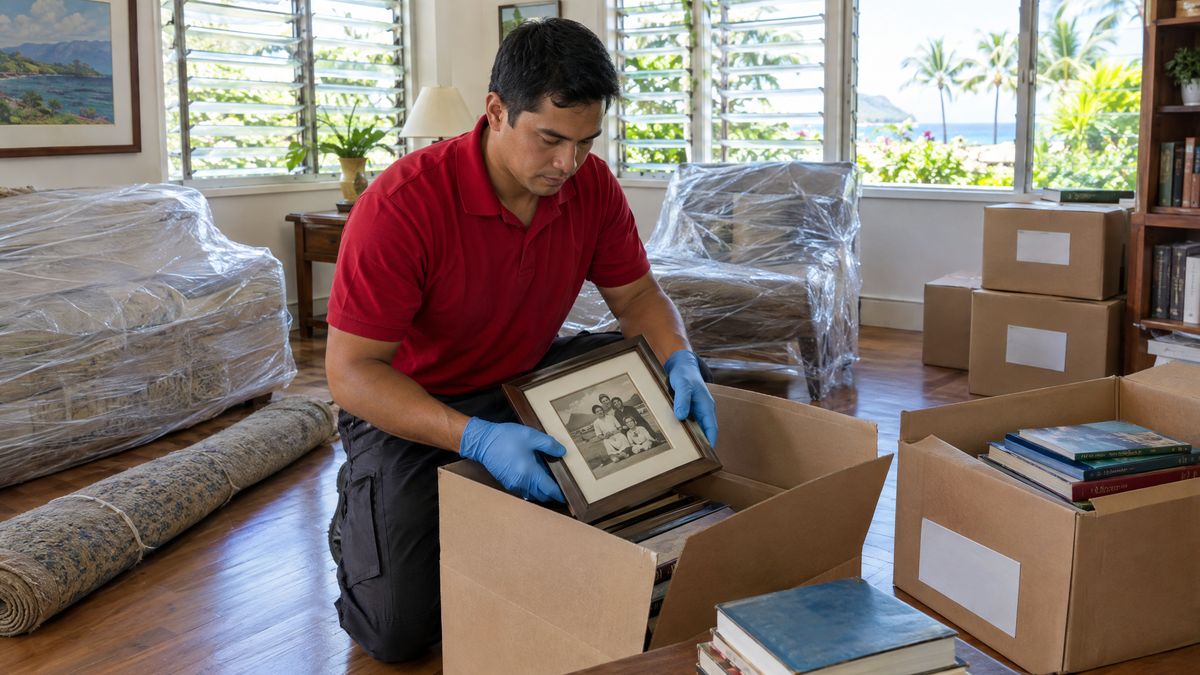
- Affected contents and stock recorded by location before anything is moved
- A dated record of when each area was closed and when it was handed back
That last item matters for a reason particular to businesses. Business interruption, also called business income, coverage is separate from the property coverage that pays for repairs; the NAIC notes it is typically bundled within a businessowner’s policy. Whether you have it, and what it pays, depends on your policy, so check it with your agent or broker. Dates of closure from the people who did the work are part of what that claim relies on.
We do not tell you what your policy covers. That is your adjuster’s call. For background before you speak to your carrier, read how restoration coverage works in Hawaii.
Commercial restoration
For Property Managers and AOAO Boards
Managers and boards need a vendor who fits their process. On request we provide a certificate of insurance, a W-9, and our general liability and workers’ compensation details, so you can approve us before anyone goes on site. References are available on request.
You get one point of contact for the manager, the board and the tenants or owners affected. Updates come in writing, in a form the manager can forward without rewriting, and questions about coverage go to the adjuster rather than being answered for owners in a hallway.
Approval runs the way your building runs it. We scope the emergency work and the repairs separately, so a board can vote on the repairs at its own pace without holding up the drying. Who may authorize what, and how fast, is set by your governing documents and management agreement. If owners ask what to report and when, our guide to the signs of a leak worth reporting to the association is written for them.
Why Rescue One
Why Business Owners and Property Managers Call Rescue One
- 01
Licensed for Commercial Work in Hawaii
Our Hawaii contractor license, BC-38891, covers the commercial work we do, and we are IICRC certified. A manager can check both before we are approved as a vendor.
We have worked on Oahu properties since 2018.
- 02
A Real Person on the Line, Day or Night
The emergency line at (808) 745-1608 is answered 24/7 by a person who can take the building’s details. Regular hours are Monday through Sunday, 7 AM to 4 PM.
We do not quote an arrival time before we know where the building is and what has happened.
- 03
Direct Billing to Your Commercial Carrier
We bill commercial carriers directly and work alongside public adjusters and third-party administrators. The file is built for the person who reviews it, with mitigation and repairs kept apart.
- 04
One Contact for the Whole Building
The manager, the board, tenants and owners all hear from the same person. That keeps one account of the job, instead of several versions passed along a hallway.
- 05
Local and Veteran-Owned, Across All of Oahu
Rescue One Restoration is locally owned and veteran-owned, and we take commercial work anywhere on Oahu.
One call starts it. We answer 24/7, anywhere on Oahu.
Reviews
What Our Customers Are Saying
When we had urgent moisture remediation service need Rescue One Restoration came to the rescue! I can’t say enough positive things about the company’s professionalism, especially from the team lead, Aaron.
When I first reached out, on a weekend, Aaron adjusted his personal schedule to come out and take a look at the issue that same day. Once work began, their work was high-quality and every team member was very professional, which was especially important to us as we are a school that had students and staff present on campus at times. Aaron did a wonderful job of being on-site daily, overseeing the project from start to finish, and keeping our administrative team updated every step of the way. Highly recommend!
We have worked extensively with Rescue One on many of the projects we manage and they are our "Go To". Paul is awesome on his communication, response and knowledge of how insurance works.
5 Stars.
Had the basement in our office flooded because of the storm, but these guys were such a HUGE HELP especially shout out to Amen and Chozyn for helping to get all the water out of the basement carefully and diligently as well as being warm, courteous and professional young adults!
During the March storms, our house took a beating. I called other places but they were all busy.
I was very lucky to have Rescue One come out to the home very quickly and leave machines to dry out the house. JJ was on top of it.
Excellent and timely service – would definitely use them again! Paul was very responsive and assisted us in our time of need.
Mahalo!
Paul and his team were professional, communicated well, worked with other contractors under strict time constraints. They were helpful & efficient in both the assessment and repair of damage.
Highly recommend.
Frequently asked questions
Commercial Restoration Questions
Don’t see your question? Call us anytime.
01Can the emergency work start before the board or the owner approves the repairs?
Usually, yes. Emergency mitigation and repairs are scoped separately for exactly this reason: the drying can be authorized on its own while the repair scope goes through the board or the owner. Who has authority to approve emergency work is set by your governing documents or management agreement, so confirm that with your manager.
02Do you work with our public adjuster or the carrier’s third-party administrator?
Yes. We work with public adjusters and third-party administrators as well as carrier adjusters, and we bill commercial carriers directly. Each gets the same documentation: photographs by area, moisture logs, and mitigation kept separate from repairs.
03Can you send a certificate of insurance and a W-9 before you come on site?
Yes. A certificate of insurance, a W-9, and our general liability and workers’ compensation details are provided on request. Ask when you call and tell us where to send them.
04Do you take small commercial jobs, like one office suite or a single restroom?
Yes. There is no minimum and no maximum. A single suite gets the same documentation and the same point of contact as a whole building.
05How are tenants and unit owners kept informed during the work?
Through one contact. We give the manager written updates that can be forwarded as they are, and the plain facts for any notice: which area is affected, what is being done, and who to ask. Questions about what insurance will pay go to the adjuster, not to us.
06Our restaurant had a sewage backup. Can we reopen as soon as the cleanup is finished?
Not on our say-so. Under Hawaii’s food safety rules, a food establishment that stopped operating because of a hazard such as a sewage backup needs the Department of Health’s approval before it resumes. What we provide is the cleanup and a written record of what was done, which supports that conversation.
07Will business interruption insurance pay while we are closed for restoration?
Only if your policy includes it, and on its terms. Business interruption is separate coverage, often part of a businessowner’s policy. Check with your agent or broker. A dated record of when each area was closed and handed back is useful either way, and we keep one.
08Can a property manager call references before hiring you?
Yes. References are available on request. Ask when you call and we will arrange them.
24/7 emergency response
One Call for the Whole Building
We take commercial jobs of any size, from a single suite to a whole building. Call (808) 745-1608, answered 24/7 by a real person, or send the details through our request form. The same number and form serve homes and businesses.
Tell us the address, the type of property, what happened and who needs to be kept informed. The on-site assessment carries a fee, credited toward the work if you go ahead with us, and it gives you documentation you can use with your carrier, your board or your tenants.
We are IICRC certified, Hawaii licensed under BC-38891, and locally owned since 2018.
24/7 emergencyAll of OahuIICRC certifiedLic. BC-38891Locally owned & operated