Water damage
If you’re reading this with water coming through your ceiling right now, we understand exactly where you are. Rescue One Restoration is a locally owned, IICRC-certified, Hawaii-licensed restoration company (Hawaii Contractor License BC-38891). We’ve responded to ceiling water damage emergencies across Oahu since 2018 — from roof leaks after heavy tropical storms in Hawaii Kai to burst attic pipes in Manoa and downtown Honolulu and upstairs bathroom overflows in Pearl City. Our team answers the phone 24 hours a day, seven days a week. Not an answering service. A real person from our Honolulu team.
This page covers everything you need to know about professional ceiling water damage restoration on Oahu — what to do in the first hour, how our process works, how insurance coordination works, and the local factors that make Hawaii’s humidity a race against the clock. When you’re ready to talk to someone, call (808) 745-1608.
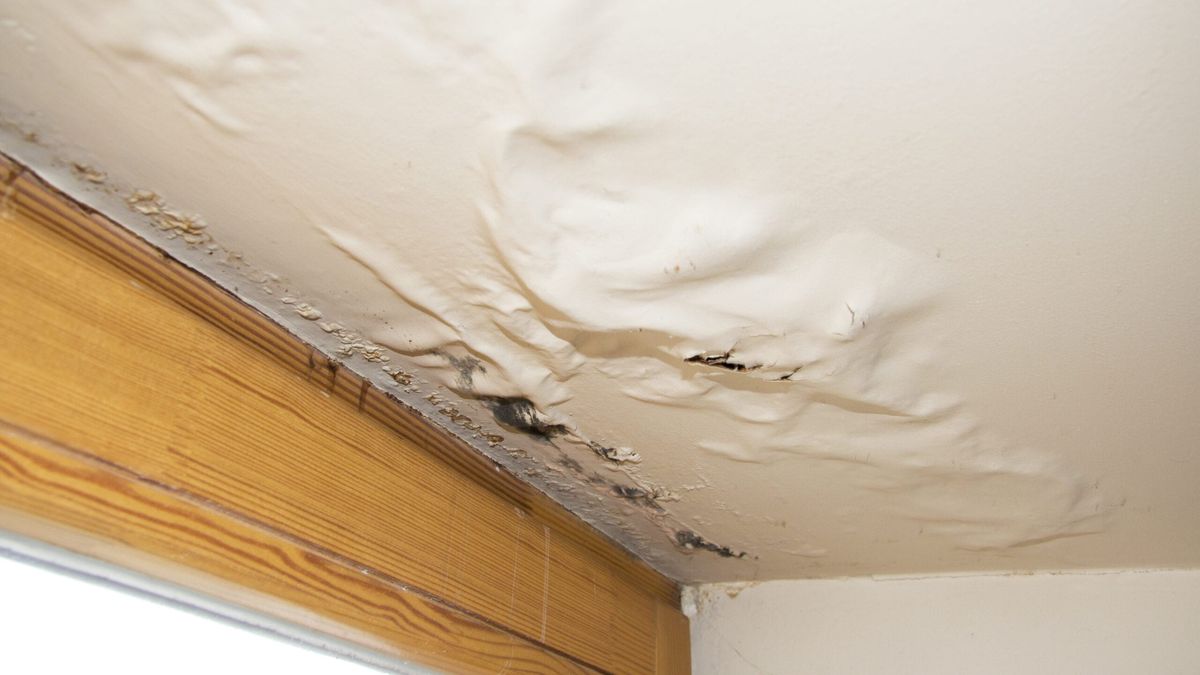
Ceiling water damage is never just a ceiling problem. By the time water has soaked through drywall, plaster, or a suspended ceiling tile, it has already traveled through the wall cavity, the insulation, the framing, the electrical wiring, and often into the flooring of the room above or the wall below. What you see on the ceiling is usually the smallest part of the total damage. Our job is to find everything you can’t see and dry it, clean it, and rebuild it properly — so the problem doesn’t return as mold, rot, or a failed insurance claim six months from now. For a deeper look at what goes wrong when water damage isn’t addressed properly, see our guide to the hidden dangers of home water damage.
Water damage
Why Professional Restoration Matters on Oahu
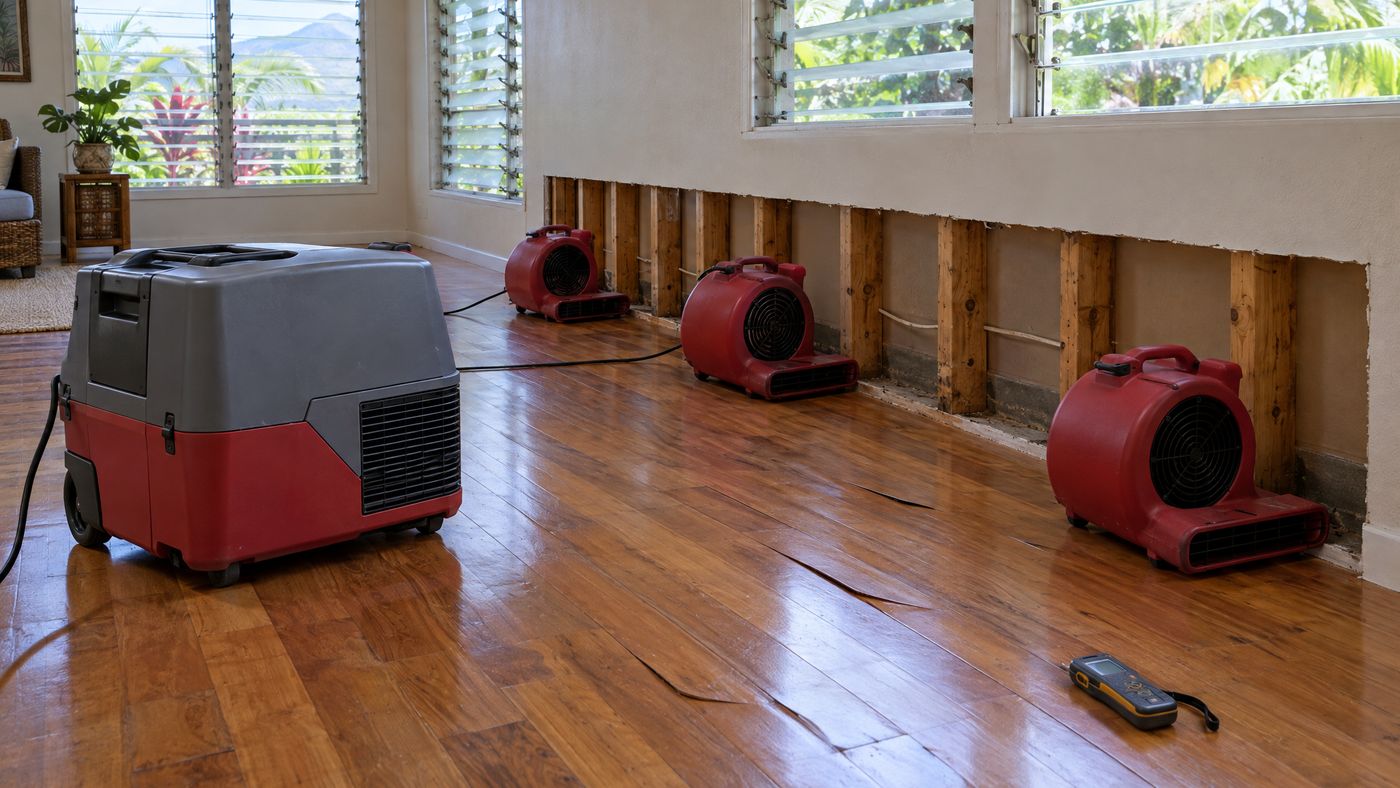
We often see homeowners try to handle ceiling leaks themselves, usually with a dehumidifier from the hardware store and a fresh coat of paint over the stain. In Hawaii’s year-round humidity, that approach almost always fails. Residual moisture in the ceiling cavity becomes mold within 24 to 48 hours. The wood framing above keeps absorbing water. The insulation loses its R-value and compacts into a damp, permanent mess. A paint-over today becomes a full ceiling replacement — plus mold abatement — within a few months. Professional restoration uses moisture meters, thermal imaging, commercial-grade dehumidifiers, and IICRC-documented drying protocols to get the structure back to a verifiable dry standard. That’s the difference between a repair that holds and a repair that fails.
Water damage
What Our Process Looks Like
When you call our Honolulu team, we tell you when a crew can be there, arrive fully equipped, and begin extraction the moment we’re on site. From there, we locate the source (coordinating with a plumber or roofer when needed), set up containment and structural drying, monitor moisture daily until materials reach proper dry standards, remove and replace anything that can’t be saved, and handle the full reconstruction — including texture matching and paint — so your ceiling looks the way it did before the damage. One team, one timeline, one invoice. You can read more about our team and how we work on our about page.
Water damage
Insurance Coordination From the First Phone Call
Most Hawaii homeowner policies cover sudden ceiling water damage — a burst supply line, an appliance failure, wind-driven rain through a compromised roof. What they don’t always cover is gradual damage the homeowner failed to mitigate. That’s why calling us first matters: we document the damage the moment we arrive, capture the photos and moisture readings your adjuster will ask for, and build the professional file that supports your claim. We work with insurance carriers serving Oahu, and you can contact us online any time to get the process started.
How it works
Our Ceiling Water Damage Restoration Process
Emergency Water Extraction and Ceiling Stabilization
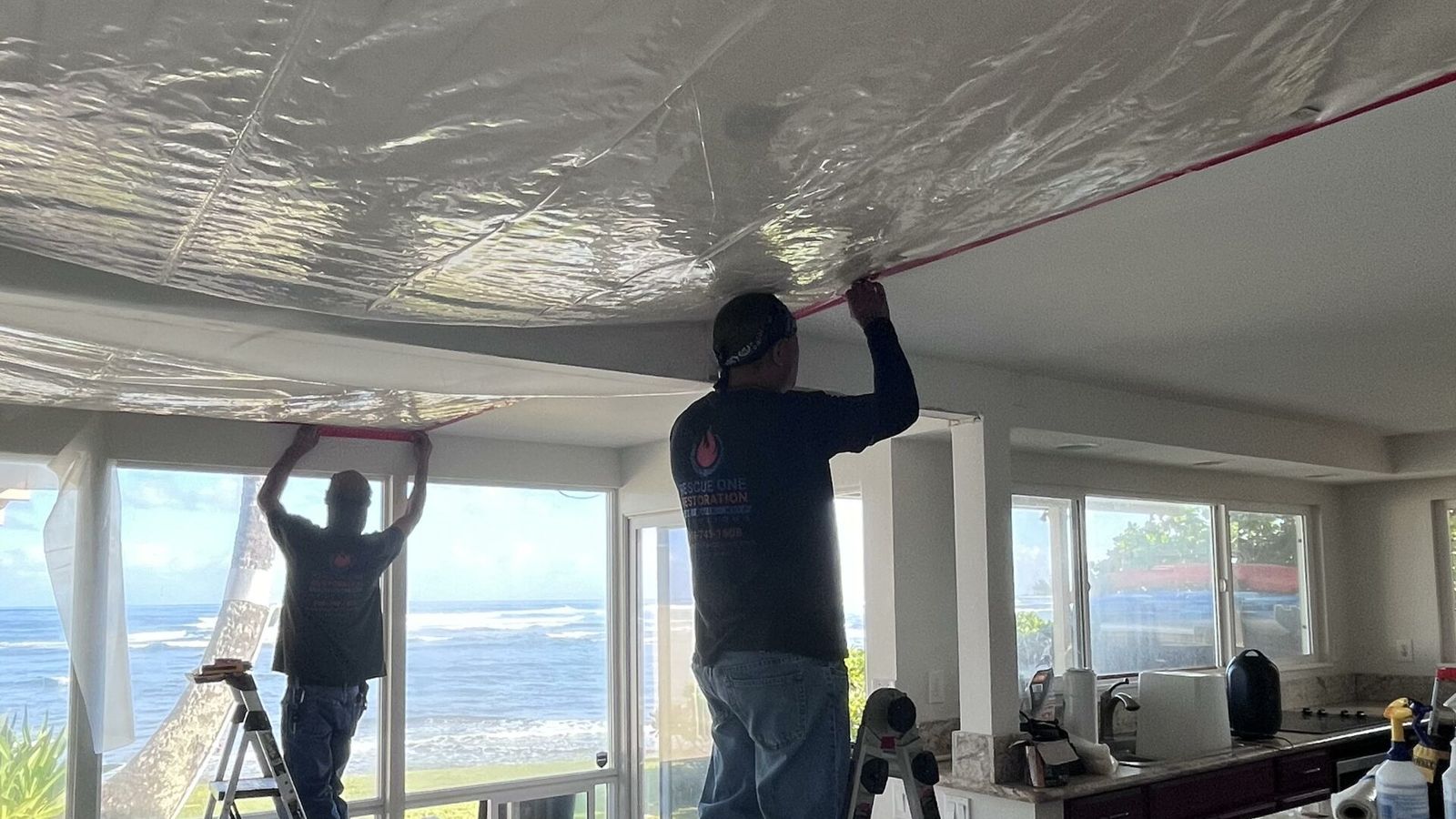
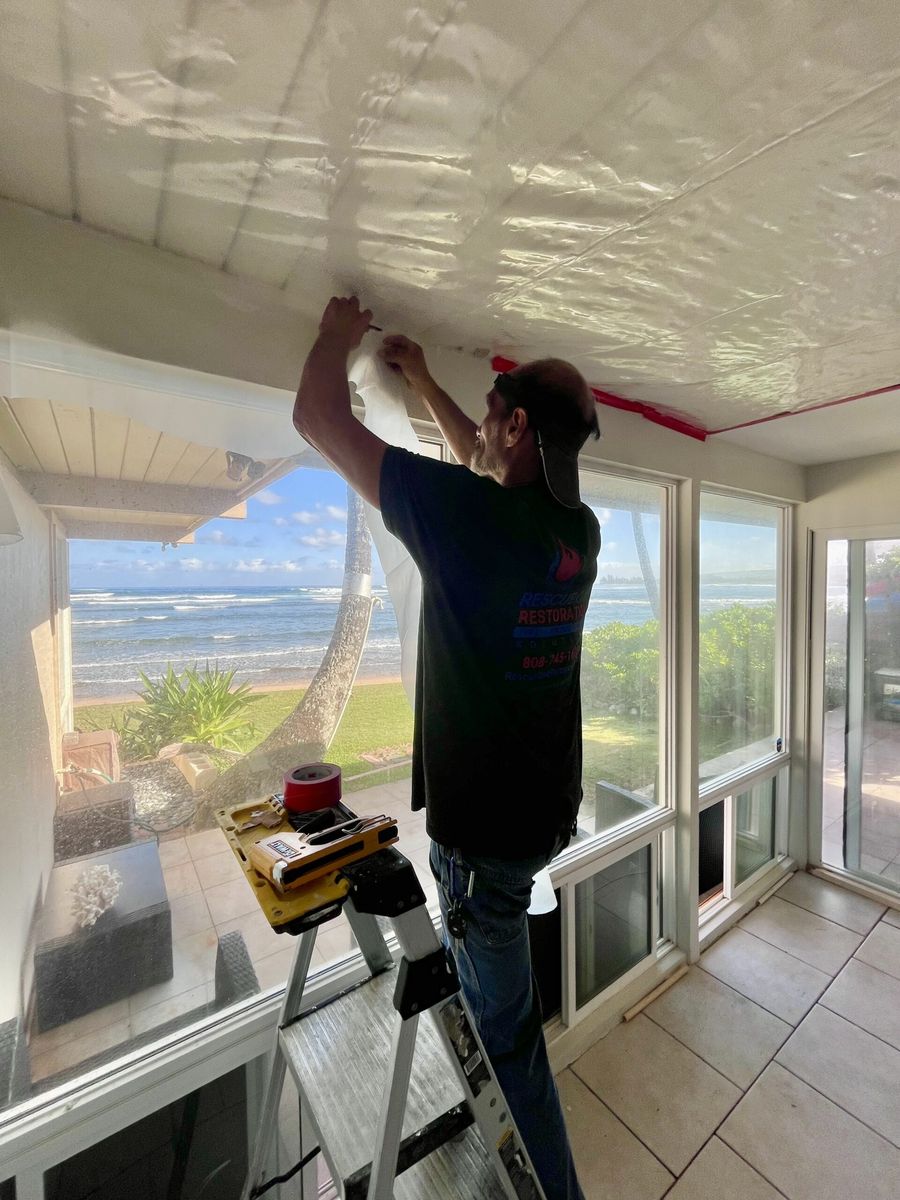
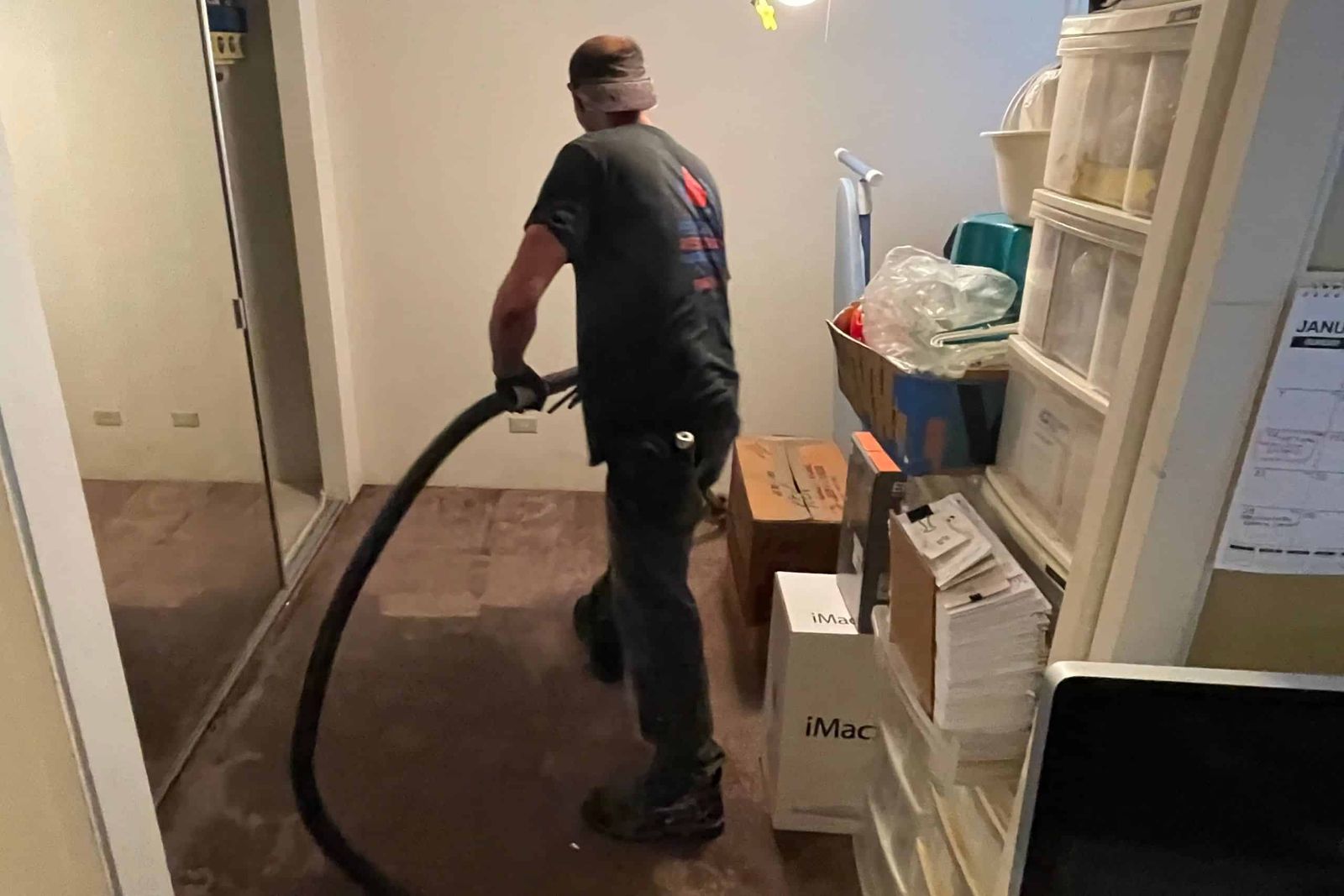
The first priority when we arrive is stopping the damage from spreading. We extract standing water from floors, contents, and any pooled water visible in the ceiling cavity using truck-mounted and portable extraction equipment — part of our rapid water extraction services. If your ceiling is sagging or bulging, we carefully relieve trapped water through a controlled drain point rather than letting the ceiling collapse on its own. This prevents secondary damage to floors, furniture, and anything else in the room below. We tarp and protect contents, move what can be moved, and set up the initial containment barriers that keep the affected area isolated from the rest of the home.
Source Identification Using Thermal Imaging
A water stain on a ceiling rarely appears directly below the source. Water travels along joists, flows along the top side of drywall, and exits at the lowest point — which can be rooms away from the actual leak. We use thermal imaging cameras and moisture meters to trace water back to its source. Our moisture detection and monitoring technology lets us map hidden moisture across walls, ceilings, and framing before we start drying. When the source turns out to be a burst pipe, we coordinate with a licensed plumber to repair it. When the source is an overflow from an upstairs bathroom, we handle the bathroom flood cleanup at the same time. When the source is roof-related — often the case after heavy storm flooding — we coordinate with a roofer and install temporary tarping to prevent further intrusion.
Structural Drying and Moisture Monitoring
Drying a ceiling in Oahu’s climate is very different from drying one on the mainland. Ambient humidity fights every dehumidifier, and if we pull moisture out of the structure without controlling the environment, it just migrates back in. We set up commercial-grade dehumidifiers, axial air movers, and — when ceiling cavities need it — injection drying systems that deliver dry air directly into wall and ceiling spaces. Our structural drying services run on daily monitoring schedules, not set-it-and-forget-it timers. We document moisture readings every day we’re on the job, so there’s a clear record that materials reached the correct dry standard before reconstruction began. For situations where a hidden leak has been going undetected, we also offer a dedicated water damage inspection to find and map every affected area.
Mold Prevention and Remediation
In Honolulu’s humidity, the window between a wet ceiling and an active mold colony is shorter than most homeowners realize. The EPA’s guidance on mold notes that colonies can begin growing on damp materials within 24 to 48 hours — and on Oahu, we often see growth at the faster end of that range. The CDC’s mold basic facts also describe the respiratory issues prolonged exposure can cause, particularly for children, kupuna, and anyone with asthma or compromised immunity. If we catch the damage early, prevention is straightforward: rapid drying, antimicrobial treatment of structural materials, and HEPA air filtration during the job. If mold is already present, we shift into full mold remediation mode — containment barriers, negative air pressure, controlled removal of contaminated materials, and post-remediation verification. Our approach follows IICRC S520 mold remediation standards, which are the protocols insurance adjusters and industrial hygienists recognize as the professional baseline.
Ceiling Reconstruction and Finish
Once the structure is verified dry, we move into reconstruction. This typically includes removing damaged drywall or plaster, replacing affected insulation, repairing any compromised framing, installing new drywall or plaster to match your existing ceiling, texture matching (popcorn, knockdown, or smooth finishes — all common in Oahu homes), priming, and painting. Our in-house full reconstruction team handles all of this under one roof — no subcontractor handoffs, no waiting weeks between phases, no gaps in accountability. When we’re finished, your ceiling should look indistinguishable from the rest of the room.
Insurance Documentation and Claim Support
Insurance coordination isn’t an afterthought for us — it runs parallel to the restoration work from day one. Our field team photographs the damage from every angle, captures daily moisture readings, logs equipment hours, and documents every material we remove or replace. That documentation goes directly into the professional file we provide to your adjuster. We speak insurance fluently: Xactimate estimates, scope of work, cause-of-loss determinations, mitigation records. For a deeper walkthrough of how coverage typically works on Oahu, see our guide to understanding insurance coverage for damage restoration in Hawaii.
Why Rescue One
Why Homeowners Trust Rescue One Restoration
- 01
IICRC Certified Protocols on Every Ceiling Water Damage Job
Rescue One Restoration is IICRC certified. This matters because IICRC standards — specifically S500 for water damage and S520 for mold remediation — are the protocols that insurance adjusters recognize and accept.
When our team documents your ceiling damage using IICRC methodology, the moisture readings, drying logs, and scope of work we produce carry professional weight. On Oahu, where ambient humidity complicates every drying project, following IICRC protocols isn’t optional. It’s the difference between a ceiling that’s dry on the surface and a structure that’s verifiably dry all the way through.
- 02
Licensed Hawaii Contractor and Locally Owned Since 2018
We founded Rescue One Restoration in 2018 and have operated under Hawaii Contractor License BC-38891 ever since. We aren’t a mainland franchise running a national playbook — we’re based in Honolulu, we live in the same neighborhoods as our customers, and we’ve restored ceilings in single-wall homes in Manoa, concrete-block construction in Pearl City, multi-story townhouses in Kapolei, and everything in between.
That local experience matters when a ceiling fails. We know how water behaves in Hawaii-specific building materials, how to work around multi-generational households, and what Oahu’s climate will do to a drying project if we cut corners.
- 03
We Work Directly With Your Insurance Company
Insurance coordination is part of what we do on every ceiling water damage job — not an upcharge, not an outsourced service. We work with the insurance carriers serving Oahu homeowners.
What that looks like in practice: we document the damage professionally from the moment we arrive, provide your adjuster with detailed scope and estimate paperwork, meet with them on site when requested, and maintain the daily logs that protect your claim from being disputed. You stay focused on your family. We handle the paperwork.
- 04
24/7 Emergency Response Across All of Oahu
Ceiling water damage doesn’t wait for business hours, and neither do we. Call (808) 745-1608 at 2 AM on a Sunday and a real person from our team answers — not a voicemail, not an answering service, not a bot.
We’ll tell you when a crew can be there once we understand what’s happening at your property. We respond island-wide: Honolulu, Kailua, Kaneohe, Aiea, Pearl City, Kapolei, Ewa Beach, Hawaii Kai, Waianae, Haleiwa, Waimanalo, and everywhere in between. Wherever you are on Oahu, we have a team that can get to you and start stabilizing the damage.
- 05
One Company From Crisis Through Completion
You shouldn’t have to coordinate a plumber, a roofer, a water damage company, a drywall contractor, and a painter to get your ceiling back. We handle everything under one roof.
When plumbing or roofing repairs are needed, we coordinate those trades directly — you keep working with a single point of contact from our team. That means one phone number, one project manager, one schedule, and one invoice. It also means one company is accountable for the result. If something needs to be corrected, there’s no finger-pointing between contractors. We own the outcome from the first emergency call through the final coat of paint.
One call starts it. We answer 24/7, anywhere on Oahu.
Reviews
What Our Customers Are Saying
When we had urgent moisture remediation service need Rescue One Restoration came to the rescue! I can’t say enough positive things about the company’s professionalism, especially from the team lead, Aaron.
When I first reached out, on a weekend, Aaron adjusted his personal schedule to come out and take a look at the issue that same day. Once work began, their work was high-quality and every team member was very professional, which was especially important to us as we are a school that had students and staff present on campus at times. Aaron did a wonderful job of being on-site daily, overseeing the project from start to finish, and keeping our administrative team updated every step of the way. Highly recommend!
We have worked extensively with Rescue One on many of the projects we manage and they are our "Go To". Paul is awesome on his communication, response and knowledge of how insurance works.
5 Stars.
Had the basement in our office flooded because of the storm, but these guys were such a HUGE HELP especially shout out to Amen and Chozyn for helping to get all the water out of the basement carefully and diligently as well as being warm, courteous and professional young adults!
During the March storms, our house took a beating. I called other places but they were all busy.
I was very lucky to have Rescue One come out to the home very quickly and leave machines to dry out the house. JJ was on top of it.
Excellent and timely service – would definitely use them again! Paul was very responsive and assisted us in our time of need.
Mahalo!
Paul and his team were professional, communicated well, worked with other contractors under strict time constraints. They were helpful & efficient in both the assessment and repair of damage.
Highly recommend.
Frequently asked questions
Frequently Asked Questions
Don’t see your question? Call us anytime.
01My ceiling is sagging but not actively leaking — should I call right now?
Yes. A sagging ceiling means water has collected above it and the drywall or plaster is starting to fail under the weight. These ceilings can drop without warning, and what you can see is rarely the full extent of the problem. Evacuate the area directly below the sag and call us at (808) 745-1608 — we’ll tell you when a crew can be there to safely relieve the trapped water and assess the structure.
02How fast can mold start growing in a wet ceiling in Hawaii?
Faster than most homeowners expect. The EPA’s general guidance is that mold can begin colonizing wet materials within 24 to 48 hours, and on Oahu our humidity pushes that toward the shorter end of the range. Professional drying — not a box fan and open windows — is what prevents a ceiling water damage job from becoming a mold remediation job.
03Should I call my insurance company before or after I call you?
Call us first. Most homeowner policies require you to mitigate further damage, and waiting days for an adjuster before starting restoration can actually jeopardize your claim. When you call us first, we begin documentation immediately and provide your insurance company with the professional scope of work they need.
04Can you save my ceiling, or will it need to be replaced?
It depends on how long the water sat, whether mold has started growing, and whether the ceiling material is still structurally sound. If we catch it early and dry everything thoroughly, we can often save the ceiling with minor repairs and repainting. If the drywall is crumbling, sagging, or showing signs of mold, replacement is safer and usually more cost-effective. We will tell you honestly which situation you are in during our on-site assessment.
05What if the leak is coming from the roof — do I also need a roofer?
Most ceiling leaks on Oahu trace back to either plumbing or roofing. When a roof repair is needed, we coordinate directly with a licensed roofer and install temporary tarping to prevent further water intrusion while the permanent repair is scheduled. You still work with one point of contact — us — and we handle the scheduling between trades.
06How long does the drying process take for ceiling water damage?
It varies based on the extent of damage, the materials involved, and how much moisture the surrounding structure absorbed. Minor ceiling leaks can be fully dry within a few days. Larger events involving saturated insulation, framing, or multiple rooms take longer. We monitor moisture readings daily and only complete the drying phase when materials have verifiably reached the correct dry standard.
07Do I need to move out of my home during the ceiling restoration?
Usually not. For most ceiling water damage jobs, we can contain the affected area and set up equipment so the rest of the home stays livable. If the damage is extensive or involves active mold remediation, temporary relocation may be safer — particularly for households with young children, kupuna, or anyone with respiratory conditions. We give you a straight answer during our initial assessment.
08Do you work with my insurance carrier?
Very likely. We work directly with insurance carriers serving Oahu. Our documentation and estimates follow the formats insurance adjusters expect, which typically makes the claims process faster and smoother.
09What areas of Oahu do you serve for ceiling water damage?
All of them. We respond island-wide, including Honolulu, Kailua, Kaneohe, Aiea, Pearl City, Kapolei, Ewa Beach, Hawaii Kai, Waianae, Haleiwa, Waimanalo, Waipahu, Waikiki, and every other Oahu community. Call (808) 745-1608 and we dispatch the nearest available team.
10What should I do in the first hour after I discover a ceiling leak?
Stay safe first — do not stand under a sagging section of ceiling, and turn off electricity to the affected area if you can do so safely. Move valuables, documents, and electronics out of the drip zone, and place buckets to catch what you can. Do not poke holes in a sagging ceiling or attempt to patch anything yourself. Then call us at (808) 745-1608 and we take it from there.
24/7 emergency response
Let’s bring your home back.
In Oahu’s climate, a wet ceiling is already on the clock. Mold colonies can form within 24 to 48 hours, drywall loses integrity by the day, and an insurance claim that could have been routine starts picking up complications the longer mitigation is delayed. Calling a professional water damage restoration team the moment you spot ceiling damage is almost always the least expensive, least disruptive path back to a finished ceiling.
If you’re dealing with ceiling water damage right now, call Rescue One Restoration at (808) 745-1608. Our Honolulu team answers the phone 24 hours a day, seven days a week — a real person, not an answering service. We’ll tell you when a crew can be there, arrive with everything needed to stabilize the damage, and coordinate every step from the first phone call through the final coat of paint. You can also contact us online any time, day or night.
We serve all of Oahu — Honolulu, Kailua, Kaneohe, Aiea, Ewa Beach, Kapolei, Hawaii Kai, Pearl City, and every community in between. Licensed (BC-38891), insured, and IICRC certified.
24/7 emergencyAll of OahuIICRC certifiedLic. BC-38891Locally owned & operated