Found mold in a Hawaii home you want to buy? Here is how disclosure, your inspection period and a written remediation scope help you decide whether to negotiate, wait or walk away.
Mold turns up in a lot of Oahu listings. Finding it is not automatically a reason to walk away. What matters is how much there is, what water is feeding it, whether that water problem has been fixed, and who pays to put it right. This guide follows the order of a purchase, from the disclosure statement to the week after you get the keys.
This is general information, not legal advice. For questions about your contract or your rights, talk to your real estate agent or a Hawaii real estate attorney.
Why mold shows up so often in Hawaii homes for sale
Mold needs moisture, and Oahu supplies plenty of it. At Honolulu’s airport, on the drier leeward side of the island, relative humidity averages 72% in the morning and 56% in the afternoon across the year, and windward neighborhoods are wetter. The EPA recommends keeping indoor humidity below 60%, so many Oahu homes sit near or above that line whenever the windows are open. Several things common to island homes add to that:
- Closed-up houses. A home that sits empty while it is listed, with the windows shut and the air conditioning off, can grow mold in places that stayed dry while someone lived there.
- Single-wall construction. Many older Oahu homes have walls one board thick, with no cavity to dry out. Moisture that gets in has fewer places to go.
- Jalousie windows, lanai doors and roof leaks. Wind-driven rain finds small gaps, and the damage often shows up as staining long after the storm.
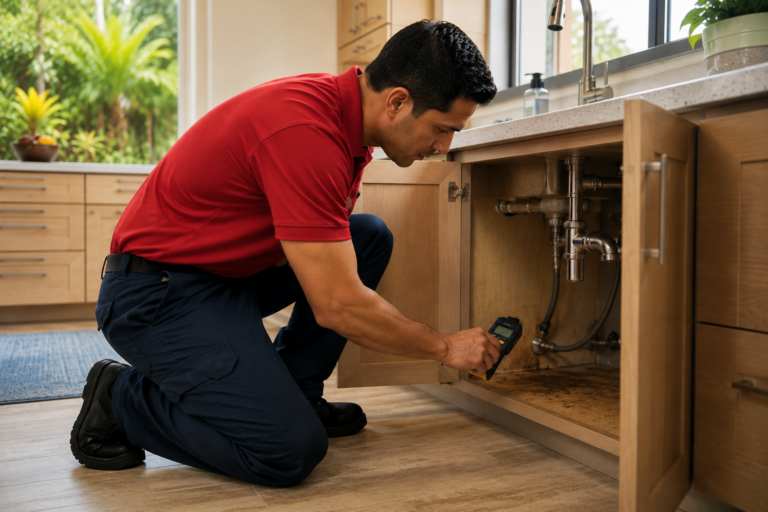
- Plumbing and air conditioning. Slow leaks under sinks, behind toilets and around air handlers keep the same spot wet for months.
So the most useful question is not “is there mold?” but “what water is feeding it, and is that fixed?” Mold that is cleaned up while the leak remains will come back. If you want to know what to look for room by room, our guide to the signs of water damage in your home walks through it.
What the seller has to tell you
Hawaii’s seller disclosure law (HRS chapter 508D) requires the seller of most homes and condo units to give you a written disclosure statement. It covers “material facts”: any condition, past or present, that would be expected to measurably affect the value of the property to a reasonable person, and that the seller knows about or that can be seen in visible, accessible areas. The law itself says the statement is not a substitute for an expert inspection.
The statement has to reach you no later than 10 calendar days after your purchase contract is accepted. Once you receive it, you have 15 calendar days to review it and decide whether to cancel. If you cancel in writing within that window, your deposit is returned. If you do nothing, you are treated as accepting it. The parties can agree in writing to shorten or extend that period, so check your contract.
The standard Hawaii Association of REALTORS disclosure form asks directly whether there has been any evidence or presence of mold, mildew or fungus, and if so, whether it was treated, when and how. It also asks about water infiltration, seepage, flooding and past damage from leaks. Read those answers closely, and ask for details on anything marked yes.
Some sales are exempt from the law, including foreclosures, later resales by the lender, and sales by court order. A bank-owned home may come with no disclosure statement at all, which makes your own inspection more important.
Use your inspection period well
Your purchase contract will usually set a period for inspections before you are fully committed. Use it, and know two things going in:
- Hawaii does not license home inspectors, and state law does not require a home inspection. Ask any inspector about their training and experience.
- A general home inspection is not a mold inspection. The two main national standards of practice, ASHI and InterNACHI, both say the inspector is not required to determine whether mold is present. A good inspector will note stains, moisture and musty smells, but a clean report is not a mold clearance.
During your showings and your inspection, look and smell in the places where mold usually starts:
- A musty smell, especially in closets, bedrooms that have been shut, and the area around the air conditioning unit
- Staining or bubbling paint on ceilings below bathrooms, at the top of walls and around windows
- Under kitchen and bathroom sinks, and the floor around toilets and water heaters
- The back walls of closets on exterior walls, and behind furniture pushed against them
- Bathroom ceilings in rooms without an exhaust fan
- Fresh paint on one patch of ceiling or wall, which can be an honest repair or a stain that was covered
If the disclosure mentions a past leak, ask for the repair records and any insurance claim paperwork. A leak that was repaired and dried properly is a very different house from one where the drywall was simply painted over.
Is mold testing worth paying for?
Often, no. The EPA says that in most cases, if mold is visible, sampling is unnecessary: you already know it is there, and the job is to remove it and fix the moisture. There are also no federal limits for mold or mold spores in the air, so a lab number on its own cannot tell you a house is safe or unsafe.
Testing can be worth it when you smell mold but cannot find it, or after remediation, to check the work was done. Our black mold page explains when testing is worth it and when it is not.
Mold and your health: what is established
The CDC says exposure to damp and moldy environments may cause a variety of health effects, or none at all. For people sensitive to mold, it can cause a stuffy nose, sore throat, coughing or wheezing, burning eyes or a skin rash. People with asthma or mold allergies may have severe reactions, and people with weakened immune systems or chronic lung disease are at higher risk.
You do not need to know the species. The CDC’s guidance is that all molds should be treated the same with respect to health risks and removal, and the EPA notes that “black mold” and “toxic mold” are not species at all. What matters for your decision is how much mold there is, what is feeding it, and who in your household would be living with it. If someone in the home has asthma, allergies or a weakened immune system, weigh that before you accept a house as is.
Get a written remediation scope before you decide
If there is more than a small spot, the most useful document you can have before your deadline is a written scope from a remediation company. It turns “there is some mold” into something you can price, schedule and negotiate with. A useful scope says:
- Which areas are affected, and roughly how large they are
- What is causing the moisture, and whether that has been fixed or still needs a plumber or roofer
- How the work area will be contained so mold is not spread through the house
- Which materials will be removed and replaced, and which can be cleaned
- How the area will be dried and checked before it is closed up
- Whether rebuilding (new drywall, paint, flooring) is included or priced separately
- How the result will be verified at the end
For a patch smaller than about 10 square feet, the EPA says most people can handle the cleanup themselves once the moisture is fixed. In a purchase, though, even a small patch is worth documenting, because what you see on the surface does not tell you how far the water went.
Rescue One Restoration can assess a home you are buying and give you a written scope. Our assessment has a fee, which is credited toward the work if you go ahead with us. You can read how the work itself is done on our mold remediation page.
Your options once you know the extent
With the disclosure, the inspection and a scope in hand, you usually have four choices:
- Ask the seller to fix it before closing. Ask for the moisture source to be repaired as well as the mold, and for the paperwork: who did the work, what the scope was, and how the result was verified.
- Ask for a credit or a lower price and arrange the work yourself after closing. This gives you control over who does the job and how.
- Accept the house as it is, if the problem is small and you have priced the fix into your offer.
- Cancel, within the time your contract and the disclosure law allow.
Timing matters as much as price. Remediation followed by rebuilding can take weeks, so check how any repair fits your closing date and your move-in plans before you agree to it.
If you find mold after you move in
Start with the water. Find and stop the leak, dry the area, and keep the room ventilated. Avoid scrubbing or tearing out large moldy areas yourself, which can spread spores through the house, and do not rely on bleach: on drywall and wood it can lighten the stain without removing the growth in the material. The EPA notes that if wet materials are dried within 24 to 48 hours of a leak, in most cases mold will not grow, so act quickly on any new leak.
Then look back at your paperwork. If the seller’s disclosure said nothing about a leak that clearly predates your purchase, talk to your agent or a real estate attorney about your options. Homeowners insurance usually treats mold according to what caused it, so a sudden covered water event is handled differently from long-term seepage. Our guide to insurance coverage for damage restoration in Hawaii covers what to ask your carrier.
Once the house is yours, the routine that keeps mold from returning is mostly about airflow and catching leaks early. Our water damage and mold prevention guide for Oahu covers it.
Talk to us before your deadline
If you are in escrow on a home with mold, or you have just moved into one, call Rescue One Restoration at (808) 745-1608 or send us a request. We will tell you what we find, what it will take to fix, and what the moisture source is, in writing you can share with your agent.