Discovering water damage in your home is unsettling — the wet stain you didn’t see yesterday, the unfamiliar musty smell, the floorboard that suddenly feels soft. What you’re seeing on the surface is usually a small fraction of what’s actually happening behind drywall, beneath flooring, and inside wall cavities. In Honolulu, where humidity stays in the 70–80% range year-round, the time between a manageable problem and an expensive crisis is measured in hours, not days.
At Rescue One Restoration, we’re an IICRC-certified, locally owned property damage restoration company serving every neighborhood on Oahu. We were founded in 2018 by a team with deep prior experience in the restoration industry, and we’ve handled water emergencies from Hawaii Kai to Kapolei — burst pipes at 2 a.m., slow leaks discovered behind kitchen cabinets, storm flooding through lanai doors. Our phone line at (808) 745-1608 is answered by a real person, 24 hours a day.
This guide walks through the hidden dangers of water damage — the structural decay, mold growth, electrical risks, and indoor air quality problems that develop out of sight — and explains why the first 24 to 48 hours after a water event are the most important.
Why Hidden Water Damage Is the Real Problem
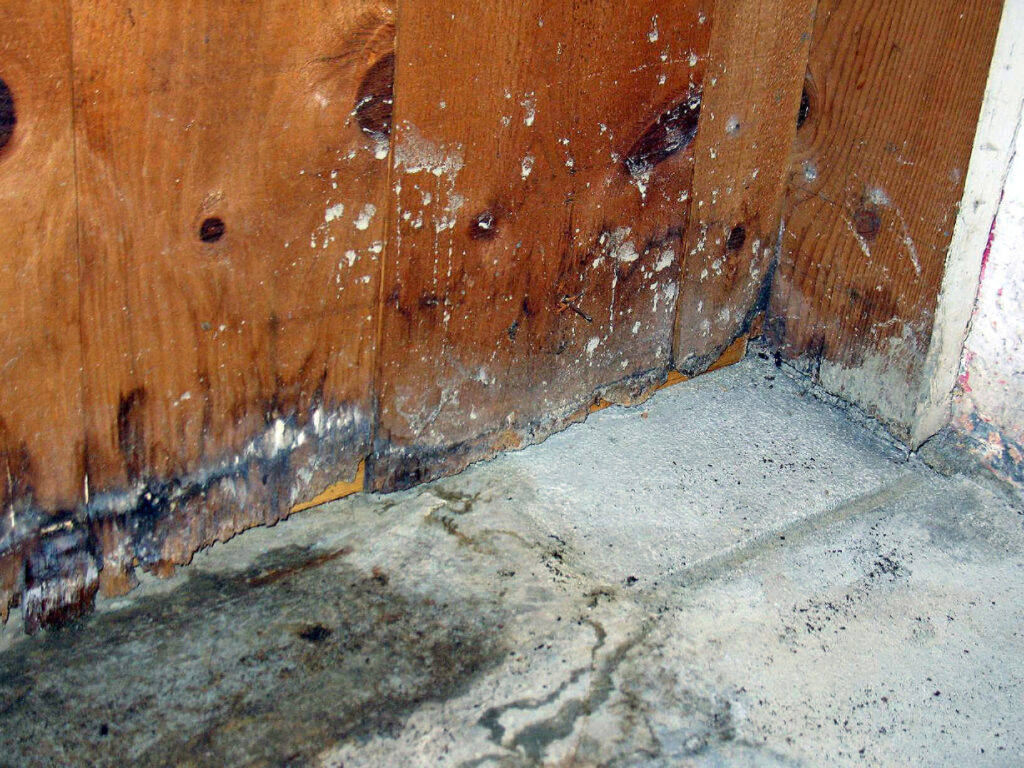
When most homeowners think about water damage, they picture the obvious: the puddle on the floor, the dripping ceiling, the soaked carpet. The reality is that water doesn’t stay where you can see it. Through a process called capillary action, water wicks upward into porous building materials like drywall and wood, sometimes climbing 12 to 18 inches above the visible waterline. It travels along framing, behind cabinets, into subfloors and joist cavities, and often into adjacent rooms that show no surface evidence of damage.
The second misconception is timing. There’s a common assumption that as long as you mop up the water and put a fan on it, you’re fine. In Hawaii’s climate, that assumption costs homeowners dearly. The Institute of Inspection, Cleaning and Restoration Certification — the body that sets technical standards for restoration work — identifies 24 to 48 hours as the window in which untreated water becomes a viable environment for microbial growth. At 70%+ ambient humidity, our island’s baseline conditions, that window shrinks. Mold spores are already in the air; all they need is a damp surface and time.
The third factor most people don’t account for is water classification. Restoration professionals work with three categories defined by IICRC standard S500:
- Category 1 (Clean water): From a supply line, water heater, or other potable source. Lowest health risk, but it degrades quickly if left untreated.
- Category 2 (Greywater): Significantly contaminated — dishwasher overflow, washing machine discharge, aquarium water. Carries bacteria and organic matter.
- Category 3 (Blackwater): Grossly contaminated — sewer backups, toilet overflow involving solids, storm surge, rising floodwater. Treated as a biohazard.
Each category requires a different response, and untreated water moves up the categories over time. A Category 1 leak that sits for 48 hours degrades to Category 2 regardless of the original source. A Category 2 leak that’s neglected escalates to Category 3. And while categorization drives the technical response, the human impact is what most homeowners actually feel — disrupted routines, kids out of their bedrooms, kupuna with respiratory conditions breathing air that’s gotten worse since the leak started. The sections below walk through the specific dangers that develop when water damage isn’t addressed quickly and correctly, and the order in which they typically appear.
Structural Damage You Can’t See Until It’s Severe
Water that wicks into framing, subfloors, and joists doesn’t announce itself. The visible drywall might dry to the touch within a day, but the studs and bottom plates behind it can stay saturated for weeks. When wood stays wet, fibers swell, then warp, then rot. On older Oahu homes — particularly the single-wall construction common in Kaimuki, Manoa, and Kalihi — water damage accelerates decay in framing that has already been stressed by termite history.
Subfloor and Joist Deterioration
Water that pools beneath flooring penetrates the subfloor and reaches the joists below. Plywood subfloors swell at the edges first, then separate from the joists. Once that bond breaks, the floor flexes, fasteners loosen, and the bounce you feel walking across the room becomes a sign of structural compromise — a job that falls under our full reconstruction scope rather than basic drying.
Concealed Wall and Ceiling Damage
Drywall is paper-faced gypsum. Once saturated, the paper face delaminates and the gypsum core crumbles — damage that often isn’t visible until paint peels or the wall is bumped. Ceilings are worse, because gravity works against you and a saturated ceiling can fail suddenly.
Mold Growth: The 48-Hour Problem in Hawaii
Mold is the most common — and most expensive — consequence of untreated water damage in Honolulu. According to the EPA, mold needs three things to grow: a food source (paper, wood, drywall, dust), moisture, and time. Hawaii’s ambient humidity supplies the moisture even after the original water source is gone. Inside a wall cavity that’s still damp, mold can establish a visible colony within 24 to 48 hours — and once it’s behind the drywall, you don’t see it until the smell appears or someone in the household develops respiratory symptoms.
The IICRC S520 standard governs professional mold remediation: containment (negative-air enclosures so spores don’t spread), HEPA-filtered air scrubbers, removal of contaminated materials, and post-remediation verification testing. Bleach and store-bought sprays don’t meet this standard — they kill what’s on the surface, not what’s inside the substrate. Our mold removal and remediation protocol is built around S520.
Electrical System Hazards
Water and electricity are an obvious bad combination, but the risk doesn’t end when the water recedes. Outlets, switches, and junction boxes that have been submerged or sprayed should be considered compromised until inspected. Inside walls, romex wiring is sheathed but not waterproof — moisture entering at connection points can corrode terminals over weeks, leading to arc faults that may not surface until a circuit overheats. After any water event, de-energize affected circuits at the breaker until a licensed electrician evaluates them, and never enter standing water in a room where outlets or appliances are still energized.
Indoor Air Quality and Respiratory Risk
Long before visible mold appears, the air inside a water-damaged home changes. Saturated drywall, carpet padding, and underlayment release volatile organic compounds (VOCs), and spore counts rise. In a household with children, elderly family members, or anyone with asthma — common across Hawaii’s multi-generational homes — these conditions can trigger symptoms within days. The CDC associates water-damaged buildings with upper respiratory symptoms, cough, and asthma exacerbation even when no mold is visible.
Pest Attraction and Compounding Damage
Damp wood is a magnet for Oahu’s existing pest pressures. Drywood and subterranean termites are drawn to softened framing. Roaches and silverfish exploit the moisture. Once a pest population establishes inside a water-damaged area, you’re solving two or three problems layered together — and restoration that addresses moisture but not the secondary infestation will have you calling another contractor in six months.
Insurance and Property Value Consequences
Homeowners often delay calling a restoration company because they’re worried about cost or about how a claim might affect their premiums. The math usually works the other way. Most standard HO-3 policies in Hawaii cover sudden and accidental water damage, but they don’t cover damage that worsens because the homeowner failed to mitigate. The longer you wait, the more likely you’ll be responsible for the secondary damage out of pocket.
Resale is the long-tail concern. Hawaii sellers must disclose known material defects, and undocumented water history can derail a sale years later. Professional restoration generates the paper trail — moisture readings, drying logs, photo documentation — that protects you when you sell. Our guide to insurance coverage in Hawaii goes deeper.
How We Respond: The Rescue One Process
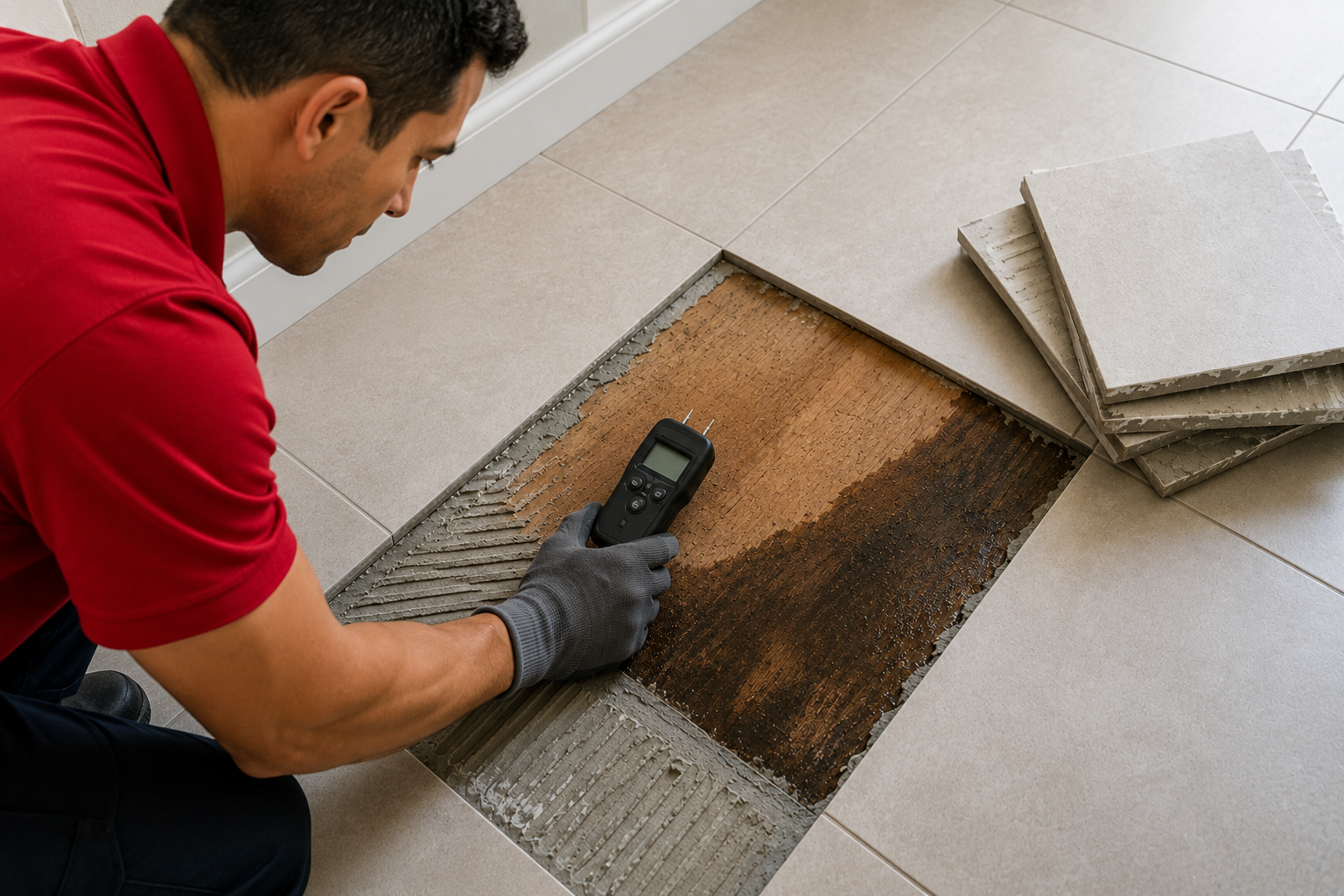
When you call (808) 745-1608, we gather basic information and dispatch the right crew with the right equipment. On-site, we start with moisture mapping — thermal imaging cameras and pin and pinless meters to find every cavity water has migrated into. From there:
- Extraction: Standing water is removed with truck-mounted or portable units — see our water extraction service.
- Controlled demolition: Wet, non-salvageable materials are removed inside containment so spores and dust don’t migrate.
- Structural drying: Industrial air movers and dehumidifiers are placed according to cubic footage and saturation level, with drying logs kept daily.
- Verification: Moisture readings continue until materials reach dry standard — not when they feel dry, when they measure dry.
- Reconstruction: Drywall, flooring, paint, and finishes are rebuilt.
- Insurance coordination: Documentation goes to your adjuster throughout. We bill direct to most major carriers.
The same process applies whether water came from a pipe failure inside the wall or from storm flooding during a Kona low — only the scope changes.
Why Homeowners Choose Rescue One Restoration
IICRC Certified — The Standard That Protects Your Insurance Claim
The Institute of Inspection, Cleaning and Restoration Certification sets the technical standards that insurance adjusters recognize and accept. When we follow IICRC protocols on your job — S500 for water damage, S520 for mold — the documentation we generate becomes the documentation that supports your claim.
On Oahu, where ambient humidity complicates every moisture-related restoration, following IICRC drying protocols isn’t optional. It’s the difference between a job that’s done and a job that stays done.
Locally Owned and Operating in Hawaii Since 2018
Rescue One Restoration was founded in 2018 by a team with years of prior experience in the property damage restoration industry. We’re a Hawaii business operating only on Oahu — we know how single-wall construction reacts to moisture, why certain older homes in Manoa and Kaimuki need different drying timelines than newer builds in Kapolei, and how the salt air affects equipment, fasteners, and finish materials.
Local means accountable. When something needs to be corrected, the people who can fix it are on the same island as your home.
Direct Insurance Coordination — We Speak Adjuster
We work directly with major insurance carriers and document every job the way adjusters need to see it: itemized scope, daily drying logs, moisture readings, photo documentation, and Xactimate-compatible pricing where appropriate. You don’t need to translate between us and your insurance company.
When something is in dispute, we provide the technical evidence to support the claim. Most of our jobs are billed direct to the carrier, which means less out-of-pocket exposure for you during the process.
24/7 Live Phone Response at (808) 745-1608
Water damage doesn’t keep business hours. Our line at (808) 745-1608 is answered by a real person around the clock — not an answering service, not voicemail, not a callback queue. When you call, you talk to someone who can dispatch a crew, ask the questions that matter for triage, and get you a realistic idea of next steps before we arrive.
Every hour matters during the first 24 to 48 hours after a water event in Hawaii’s humidity, and we operate accordingly — including nights, weekends, and holidays.
Hawaii Licensed Contractor BC-38891 — Trained In-House Team
We hold Hawaii contractor license BC-38891, and the technicians on your job are our own employees — IICRC-trained, background-checked, and uniformed. We don’t subcontract the work to a rotating cast of crews from outside the company.
That continuity matters. The technician who arrives on day one is part of the same crew that hands the home back to you when the job is finished, which means one consistent point of accountability from extraction through reconstruction — and one team that’s seen the whole arc of the job.
Frequently Asked Questions
How fast does mold develop after water damage in Honolulu homes?
Mold can begin establishing within 24 to 48 hours when materials stay damp at room temperature. In Hawaii’s year-round humidity, that timeline often runs at the shorter end. Once mold is behind the drywall, the cost to remediate it is significantly higher than the cost of drying the original water damage properly.
Will homeowners insurance cover hidden water damage?
Most HO-3 policies in Hawaii cover sudden and accidental water damage — a burst pipe, an appliance failure, a roof leak from a covered storm event. Gradual leaks and damage from deferred maintenance are typically excluded, and flood damage from rising water requires separate NFIP coverage. We document every job in the format adjusters expect, which protects your claim.
Can I dry water damage myself with fans and a dehumidifier?
Household fans and consumer dehumidifiers move surface moisture, but they don’t address water that has wicked into framing, subfloors, or wall cavities. Professional drying uses industrial air movers and commercial dehumidifiers placed and monitored by IICRC-certified technicians, with daily moisture readings to verify materials actually reach dry standard. DIY drying often leaves materials at moisture levels that feel dry but still support mold growth.
What’s the difference between Category 1, 2, and 3 water damage?
Category 1 is clean water from a sanitary source like a supply line. Category 2 (greywater) is contaminated with bacteria or organic matter — dishwasher discharge, washing machine overflow. Category 3 (blackwater) is grossly contaminated — sewer backups, storm surge, flooding from outside the property. Each category requires a different response, and untreated water moves up the categories over time.
How do you find water damage I can’t see?
We use thermal imaging cameras to identify temperature differentials behind wall surfaces, along with pin and pinless moisture meters to verify moisture content in framing, drywall, and subfloors. The moisture map we generate shows where water has migrated, which guides where drying equipment goes and where demolition may be needed.
How long does the water damage restoration process take?
Drying typically runs three to seven days depending on scope and the materials involved. Reconstruction — replacing drywall, flooring, paint, and finishes — varies more widely based on what needs to be rebuilt. We give you a realistic timeline after the initial moisture mapping on-site, with daily updates as drying progresses.
Is it safe to stay in my home during water damage restoration?
For contained water damage in one or two rooms, most homeowners can stay. When mold remediation is involved or when significant demolition affects shared living areas like the kitchen, temporary relocation is usually recommended. We give you an honest assessment based on what we find during the initial inspection.
What should I do in the first 30 minutes after discovering water damage?
Stop the source if you can do so safely — shut off the water main if it’s a supply line failure. Move valuables and electronics out of the affected area. Take photos for your insurance claim. Don’t enter standing water near outlets or electrical equipment. Then call us at (808) 745-1608 — the sooner we start moisture mapping and extraction, the less damage spreads.
What if I find mold weeks or months after the original water event?
That’s a common scenario in Hawaii, especially when the original water damage wasn’t dried to standard. We handle it under IICRC S520 — containment, HEPA air scrubbing, removal of contaminated materials, and post-remediation verification. The original water source needs to be identified and corrected, or the mold will return.
Do you serve neighborhoods outside Honolulu?
We serve all of Oahu — from Kailua and Kaneohe on the windward side to Hawaii Kai, Kahala, and Manoa, to Pearl City, Ewa Beach, Kapolei, and Waianae. Travel time varies by location and time of day, but we dispatch to every part of the island.
Get Help Before Hidden Damage Compounds
Water damage you can see is usually the smallest part of the problem. The structural decay behind drywall, the mold beginning to grow in wall cavities, the corroded wiring inside an outlet box — these are the costs that compound when water damage isn’t addressed within the first 24 to 48 hours. Hawaii’s humidity doesn’t give homeowners the buffer the mainland does.
If you’re dealing with water damage in your home — or if you suspect there’s something hiding behind a wall that doesn’t look quite right — call us at (808) 745-1608. We answer the phone live, 24 hours a day, every day of the year. We’re IICRC certified, Hawaii licensed (BC-38891), and locally owned and operating on Oahu since 2018. Learn more about our water damage restoration service or contact us to start a conversation.
The sooner we can get on-site to map the moisture and begin drying, the less damage spreads. From us to you, mahalo for trusting Rescue One Restoration with your home.
Two homes on the same street take on the same amount of water from the same storm. One is dry and back to normal in a few days with no materials removed. The other loses its flooring, the bottom two feet of drywall, and its kitchen cabinetry. The difference usually
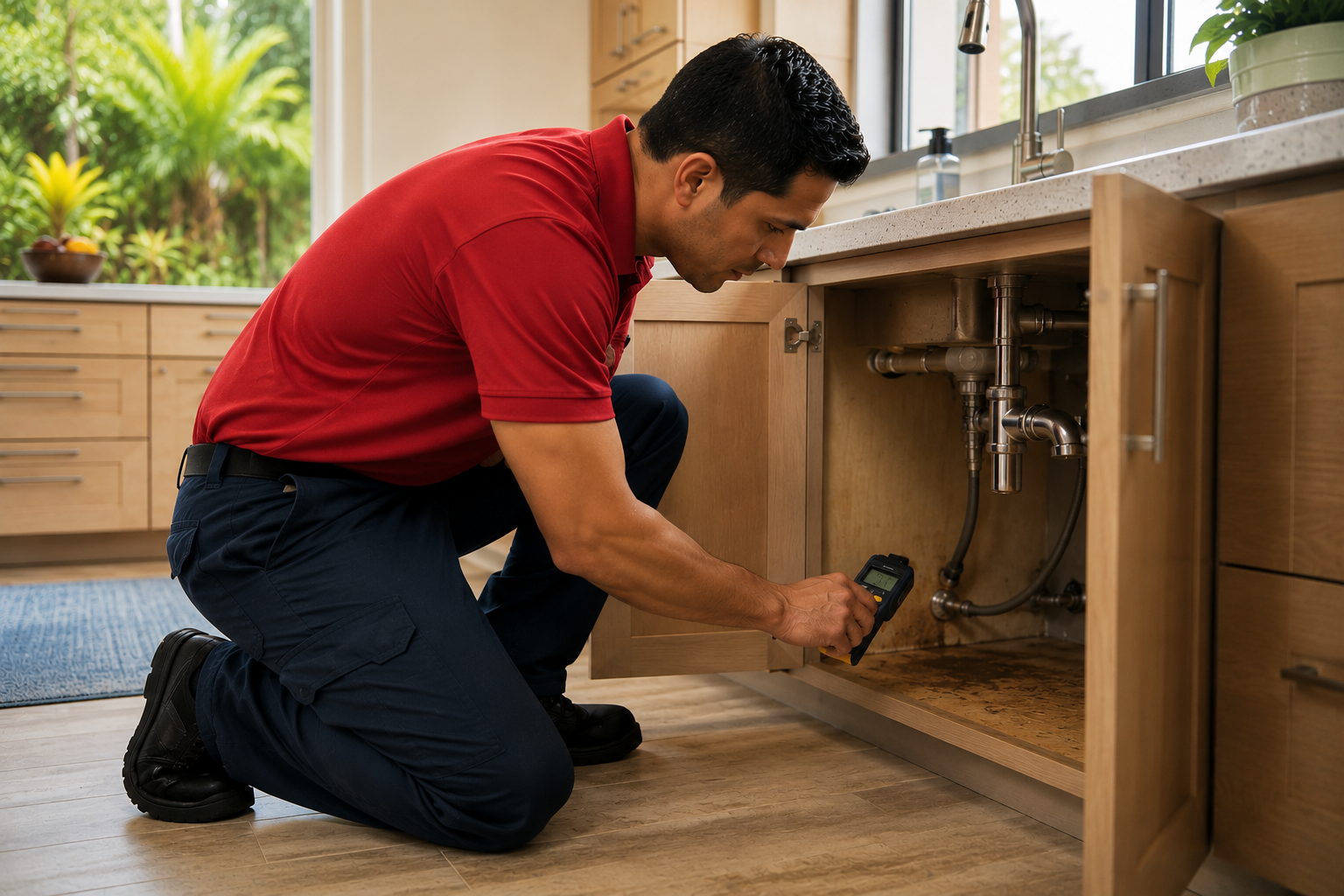
Most of the water damage we restore on Oahu did not start as an emergency. It started as something small and quiet that nobody noticed — a supply line weeping behind a dishwasher, a hairline crack in shower grout, a downspout discharging against a foundation for two rainy seasons. The
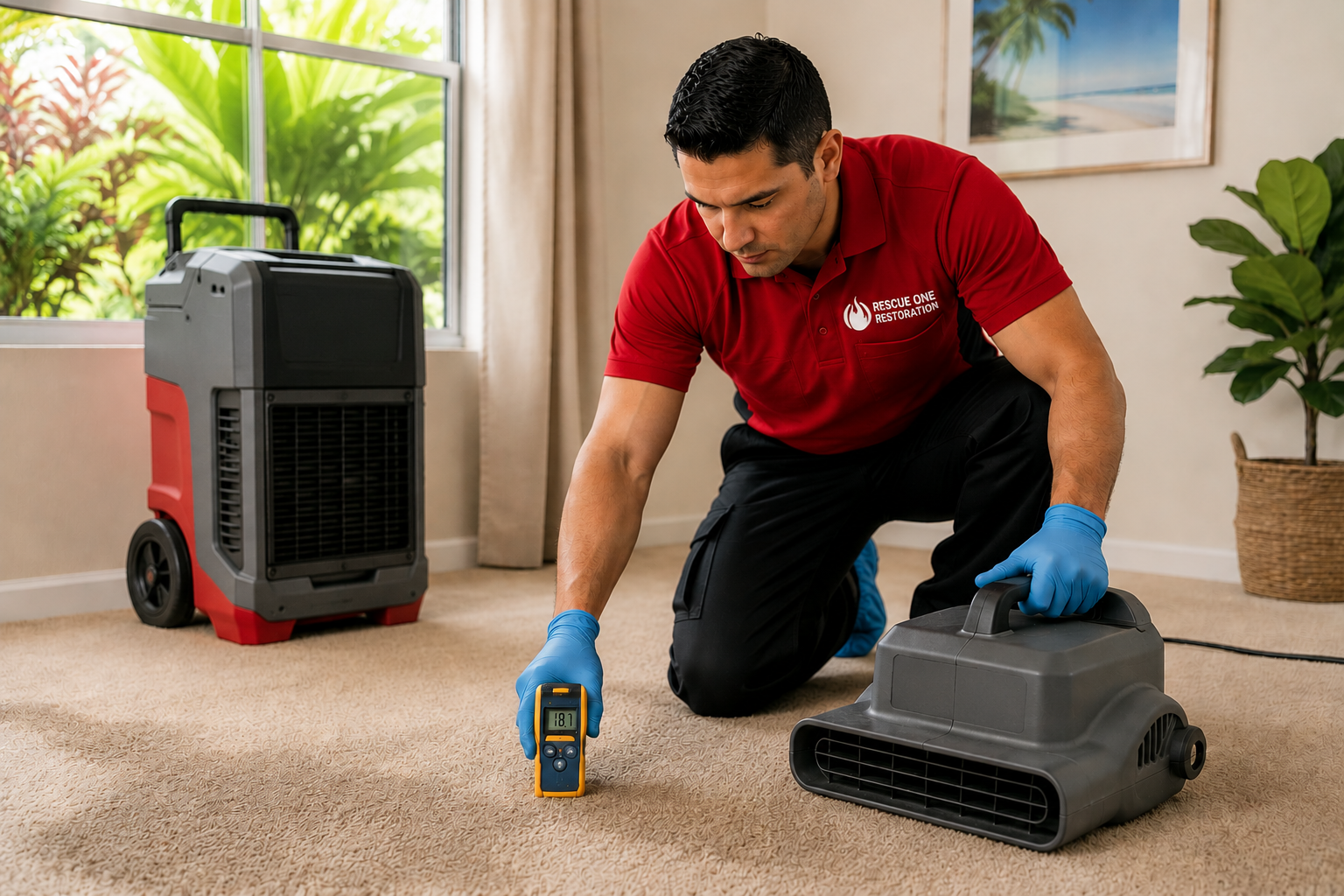
Few things unsettle a homeowner like the squish of a soaked carpet underfoot. Maybe a supply line let go overnight and you woke to a dark stain spreading across the bedroom. Maybe a slow-moving low-pressure system pushed rain across the lanai and into the living room while you slept. Either
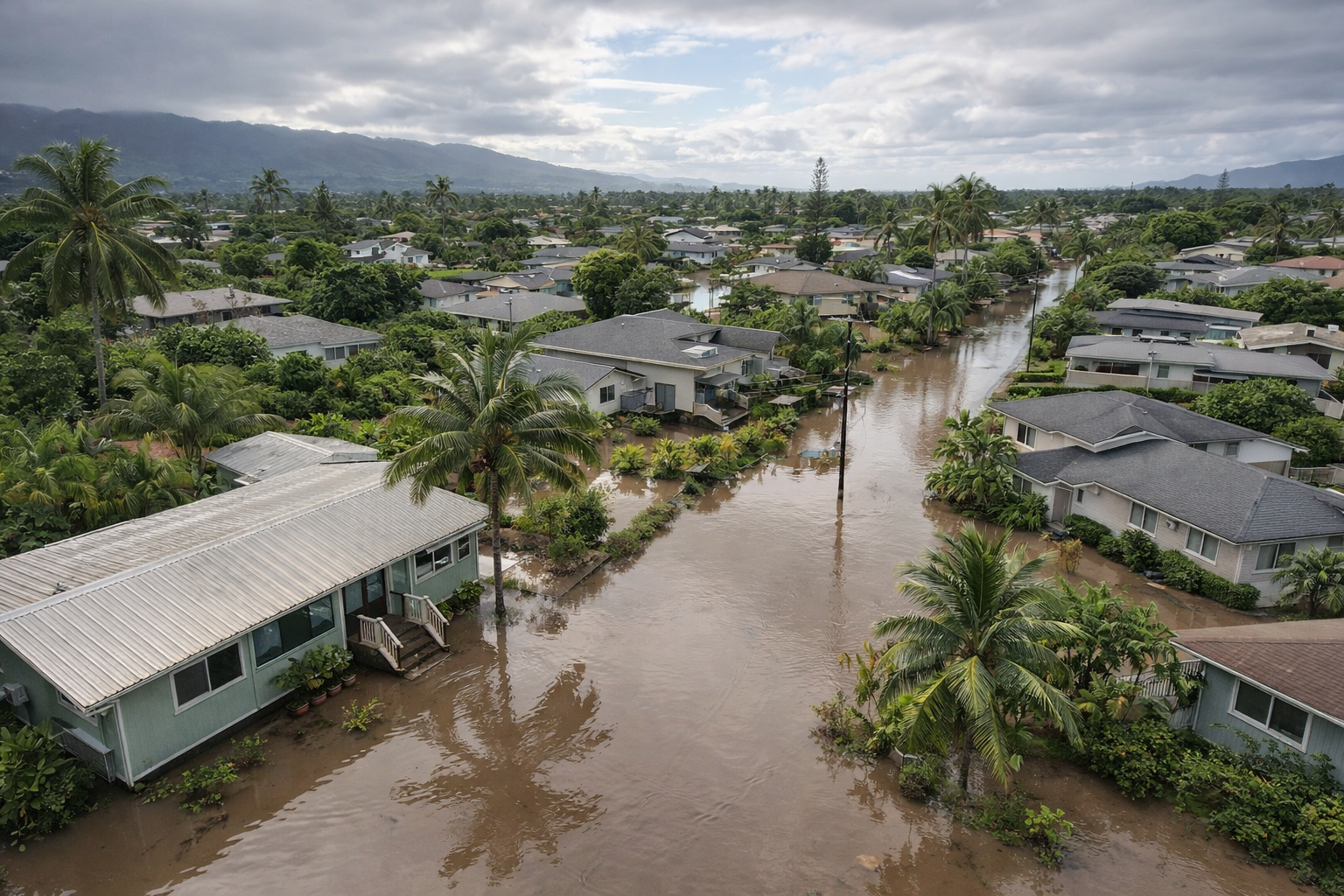
Oahu Homeowners: What to Do Right Now After the March 2026 Storm & Flooding A Step-by-Step Guide from Your Local Oahu Restoration Team The call came in just after midnight on March 20th. A homeowner in Waialua. Water in the hallway. Water in the living room. Water pressing up through
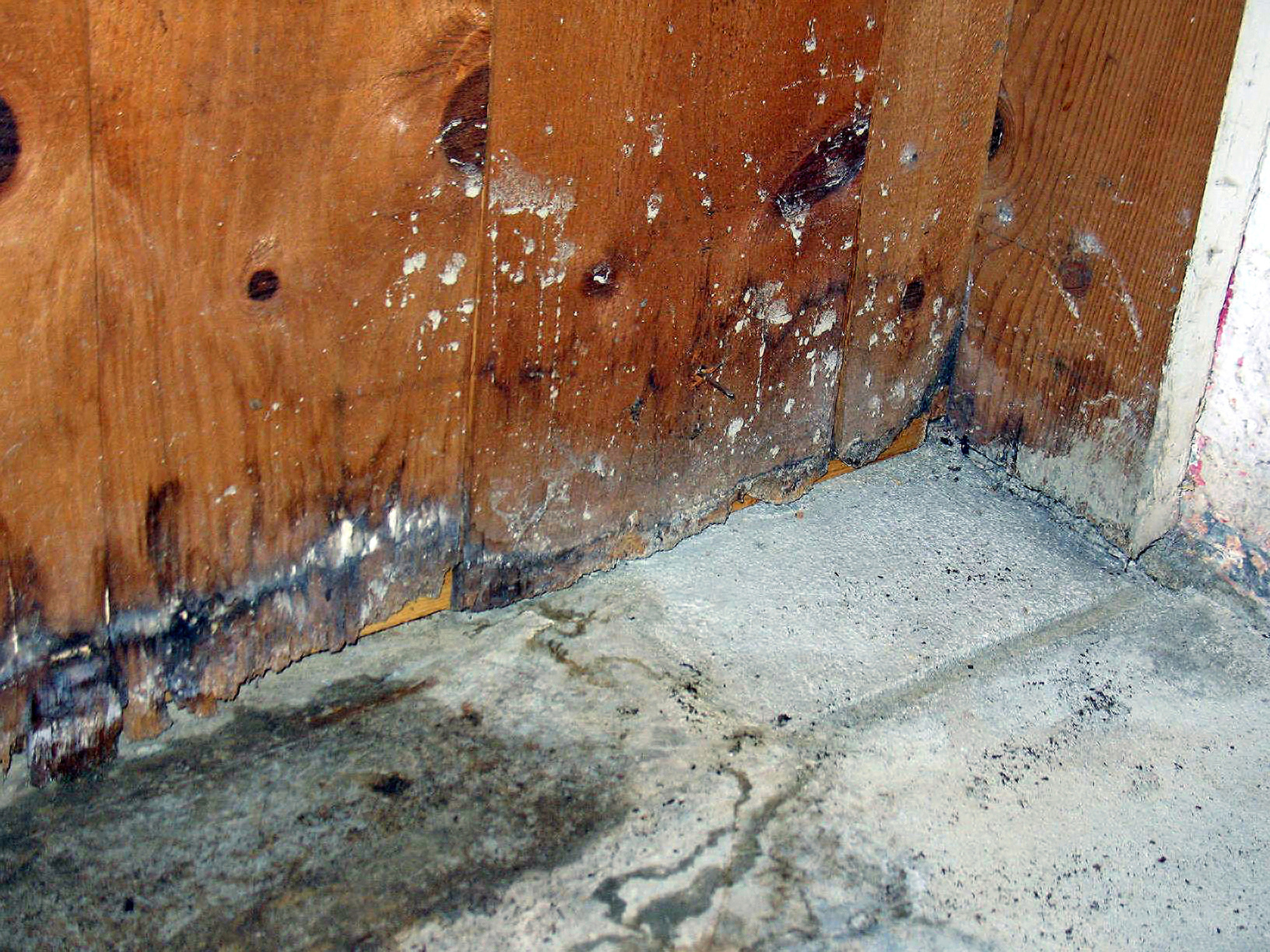
Discovering water damage in your home is unsettling — the wet stain you didn’t see yesterday, the unfamiliar musty smell, the floorboard that suddenly feels soft. What you’re seeing on the surface is usually a small fraction of what’s actually happening behind drywall, beneath flooring, and inside wall cavities. In